
The “Sala delle Pittrici” at Museo di Roma–Palazzo Braschi
Guest post by Alessandra Masu, author, journalist and art historian
As of December 5, 2025, the Museo di Roma–Palazzo Braschi presents the new Room “Roma Pittrice: Women Artists in Modern Age Rome.” The Sala delle Pittrici is the first permanent Room in an Italian museum exclusively devoted to women artists active in Modern Age Italy. The Room is curated by Ilaria Miarelli Mariani, with my collaboration.
The entirely new Room opens in the wake of the success of the pioneering exhibition Roma Pittrice: Women Artists at Work in Rome between the Sixteenth and Nineteenth Centuries (2024–2025; read my review here). Since December 5th, on the recently renovated third floor of the eighteenth-century palace built in the heart of Renaissance-Baroque Rome, the Sala delle Pittrici shows an anthology of works by women artists active in Rome between the sixteenth and nineteenth centuries, who contributed to make the Urbs the Capital of the Arts in Modern Age Europe.
The composition of the Room
Introduced by the beautiful Nemi Room, an oval space decorated with views of the Braschi family’s possessions, the display begins with two maps of Rome featuring the artists’ homes and studios. The maps were created for the 2024–2025 exhibition; the digital versions are constantly updated.
The new Room contains 15 of the 134 works from the “Roma Pittrice” exhibition. Other than Artemisia Gentileschi’s Aurora, from my collection, these paintings are all from the storage of Rome’s Civic Museums. To these 15 works we added two more: the Portrait of Faustina Maratti (1679–1745), also discovered in the storage of the Civic Museums, and my Capriccio by Maria Luigia Raggi (1742–1813), of the same series in the Capitoline Museums, which was exhibited in the 2024–2025 “Roma Pittrice” exhibit.
The artists
Following are illustrations and descriptions of just a few of the 17 paintings that the Room now makes accessible to visitors. I also present information about the works of other artists that the Sala delle Pittrici celebrates.
Artemisia Gentileschi and Maria Luigia Raggi
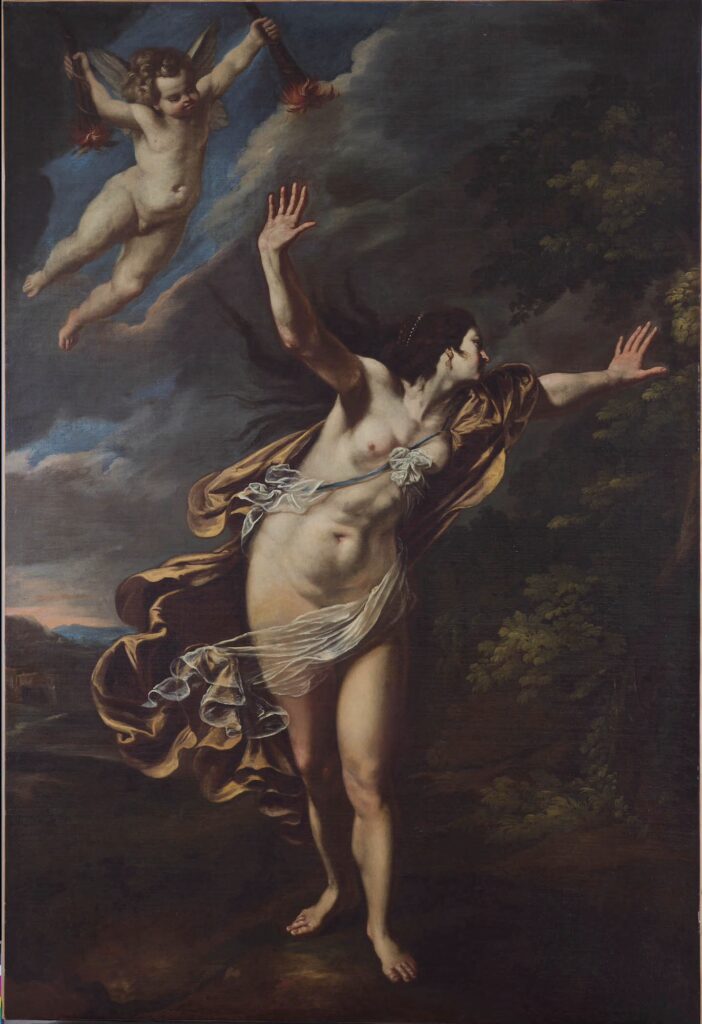
Upon entering the Room, visitors immediately encounter Aurora, by Artemisia Gentileschi (1593–post August 1654) from my collection, which Sheila Barker dated circa 1645. I secured the long-term loan of this painting, and a Capriccio by Maria Luigia Raggi (1742–1813), to support the idea of Ilaria Miarelli Mariani, Director of Rome’s Civic Museums, of giving a lasting follow-up to the “Roma Pittrice” exhibition. Raggi was a Genoese noble woman forced to become a nun, but she should have been in Rome in 1781, a guest of her uncle Ferdinando Raggi, who that very year was elected Prince of the Academy of San Luca.
Louise Seidler
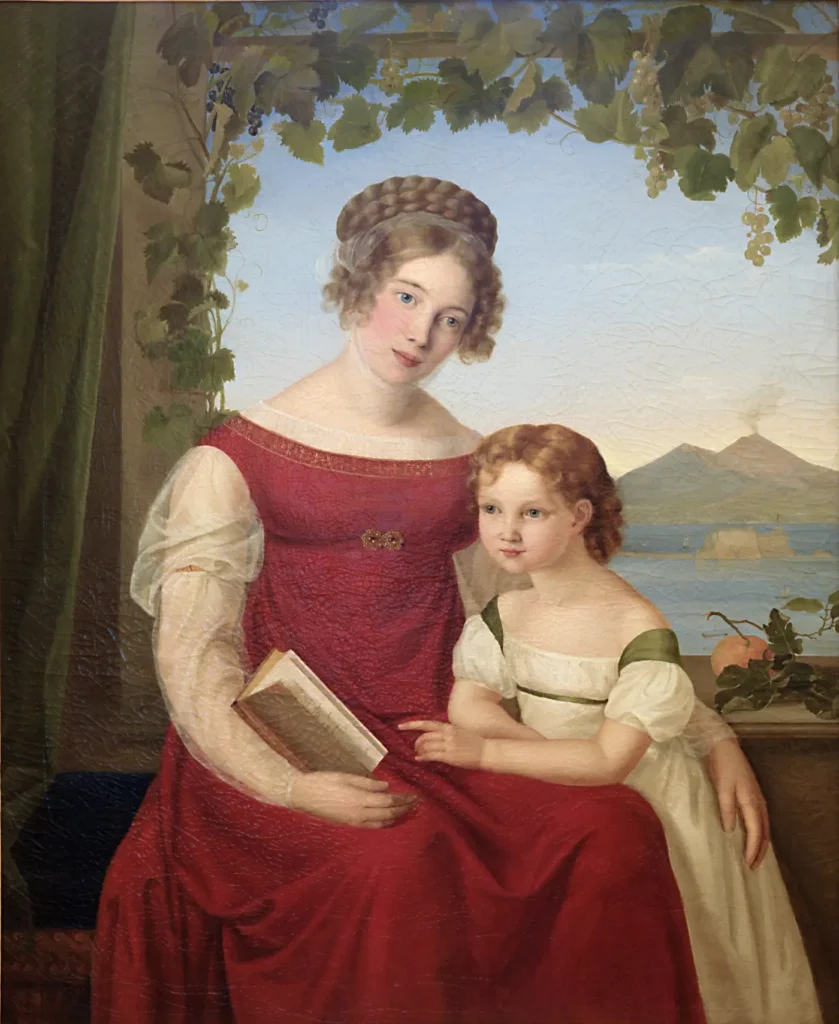
Another key piece is Louise Seidler’s portrait of the baroness Dorothea Denecke von Ramdorh with her daughter Lilli with a view of the Vesuvius (Museo di Roma). The German painter Louise Seidler (1786–1866) was based in Rome from 1817 to 1823. She was the only female artist to exhibit in the Nazarenes exhibition in Palazzo Caffarelli on the Campidoglio in 1819, the year in which she executed the portrait during a stay in Naples.
Emma Gaggioti Richards
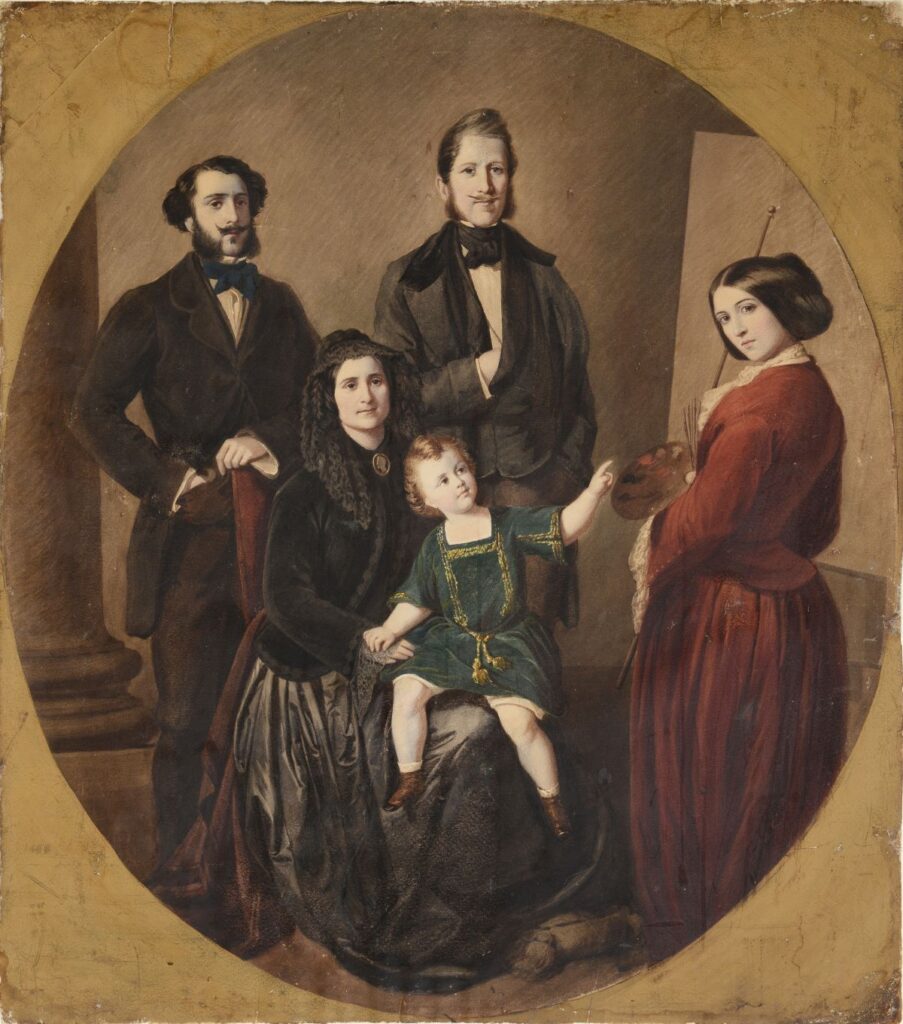
Also from the Museo di Roma is the brilliant Self-Portrait with her Family by the Roman Emma Gaggiotti Richards (1825–1912). This painting graced the cover of the catalog of the “Roma Pittrice” exhibition. Gaggiotti was very active in the Risorgimento movements. Contemporary artists and poets, including Giuseppe Gioacchino Belli, praised her for her many talents. The artist reproduced the portrait for very prestigious clients, including Queen Victoria.
… And more
Also on display are the elevations of the Villa “Il Vascello” on the Gianicolo Hill, by the first (and only, for the entire Ancien Régime) Roman “architettrice” (and painter), Plautilla Bricci (1616–1692). The latter work, her masterpiece, was almost destroyed during the 1849 siege of Rome.
Several works represent the golden age of the Grand Tour, the eighteenth century. There is a recently rediscovered portrait of the Arcadian poet (and a painter, a pupil of her father Carlo Maratti), Faustina Maratti Zappi (1679–1745). And from this time period there are two engravings, by Laura Piranesi and Teresa del Pò.
Finally, the Room also presents
- Three paintings by Erminia De Sanctis (1840–1919), and one of her, by her brother Guglielmo;
- Two paintings by Virginia Barlocci (1824–1898);
- Two paintings by unknown artists; and
- One painting each by Jane Benham (1829–1904) and Amalia De Angelis (1851–1871).
Author, journalist and art historian Alessandra Masu loves to unearth the stories of overlooked women. She collects art created by women from the sixteenth to the twenty-first century. Alessandra’s writing has appeared in many places in print including D, la Repubblica’s weekly style magazine.
As an art historian, Alessandra has contributed to several exhibitions and art publications. She is the author of the historical novel Lena, che è donna di Caravaggio. In 2025 Ginevra Bentivoglio Editoria published a second edition of her book Perchè io non voglio star più a questa vita. La voce di Beatrice Cenci dai documenti conservati negli archivi romani (originally published in 2020). In 2016 Alessandra, in collaboration with art historians Consuelo Lollobrigida and Beatrice De Ruggieri, founded the cultural association Artemisia Gentileschi, which is based in Rome. On March 8, International Women’s Day 2022, the association launched the Artemisie Museum project. It is the first virtual museum-database of women in the arts.
More posts by Alessandra Masu
Roma Pittrice: Women Artists at Work in Rome Between the Sixteenth and Nineteenth Centuries
Carlotta Gargalli 1788–1840: “The Elisabetta Sirani of the Day”
Judith’s Challenge, from Lavinia Fontana to Artemisia Gentileschi
Plautilla Bricci: A Painter & “Architettrice” in Seventeenth-century Rome
More Art Herstory news posts
Museum Exhibitions about Historic Women Artists: 2026
The Rijksmuseum Opens Its “Gallery of Honor” to Women Artists
The National Gallery of Ireland Prioritizes the Acquisition of Art by Women