Julia McEntee Dillon and Blanche Lazzell
by Erika Gaffney, Art Herstory Founder

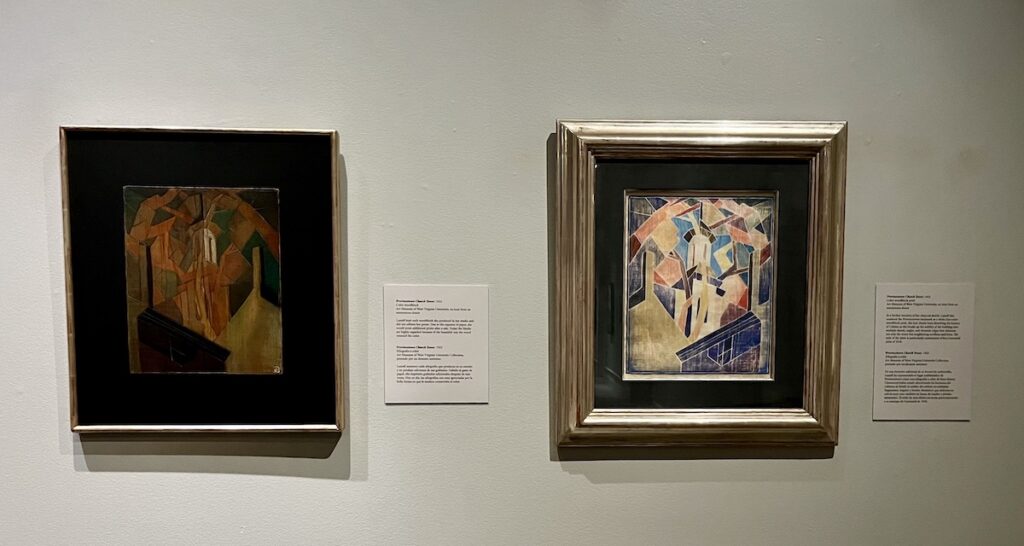
Right: The White Petunia, block cut 1932, printed 1954, by Blanche Lazzell; Art Museum of West Virginia University Collection
From mid-winter to late summer 2026, visitors to the Albany Institute of History and Art can immerse themselves in the art of two historic American women. The museum offers a monographic exhibition apiece on Julia McEntee Dillon (1834–1919) and Blanche Lazzell (1878–1956). These shows give visitors access to the stories and achievements of two extraordinary artists.
- A Life in Bloom: The Floral Paintings of Julia McEntee Dillon presents the career of one of the most admired yet underrecognized American painters of the nineteenth century. Dillon rendered peonies, roses, and chrysanthemums so vividly that critics remarked they “almost seem to have an odor in them.”
- Blanche Lazzell: Becoming an American Modernist surveys the pioneering artist’s lifelong pursuit of translating Modernism into an American art form. The show celebrates her largely unsung achievements in championing abstraction in the United States through painting and printmaking.
These two artists were born 44 years apart, in different regions of the United States. Coincidentally, each woman was one of ten children; and neither had any children herself. More significantly, each chose an unconventional path for a woman of her time, pursuing artistic education and eventually a career as a professional artist. And each has yet to receive widespread recognition and appreciation for her contributions to American art.
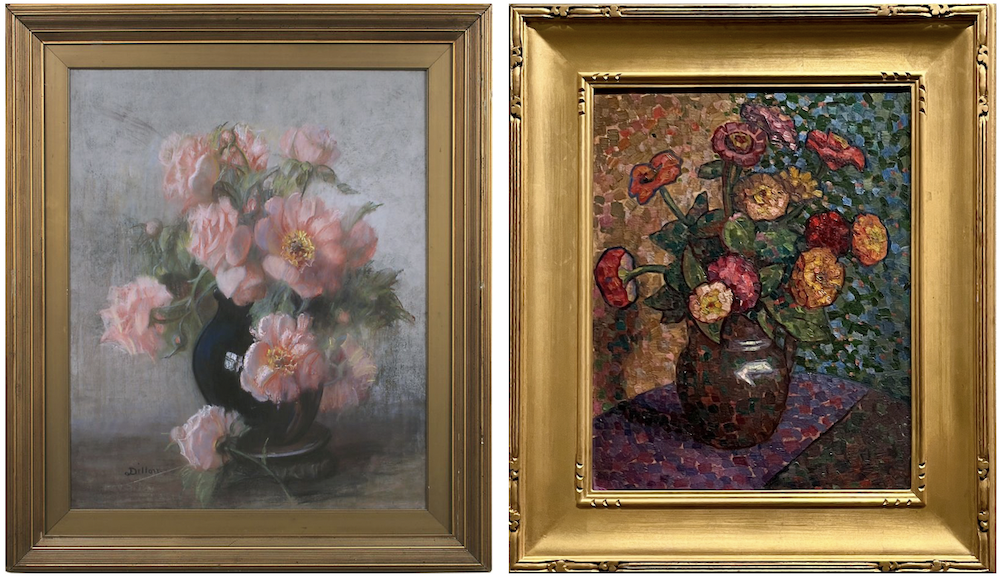
Right: Untitled, c. 1917, by Blanche Lazzell; Art Museum of West Virginia University Collection
Julia McEntee Dillon
A Life in Bloom: The Floral Paintings of Julia McEntee Dillon represents an exceptional assemblage of the work of the nineteenth-century artist. It brings together 30-some still life flower paintings, on loan from public collections—such as regional historical societies, and a church—and private collectors, as well as a few photographs and other contextual material.
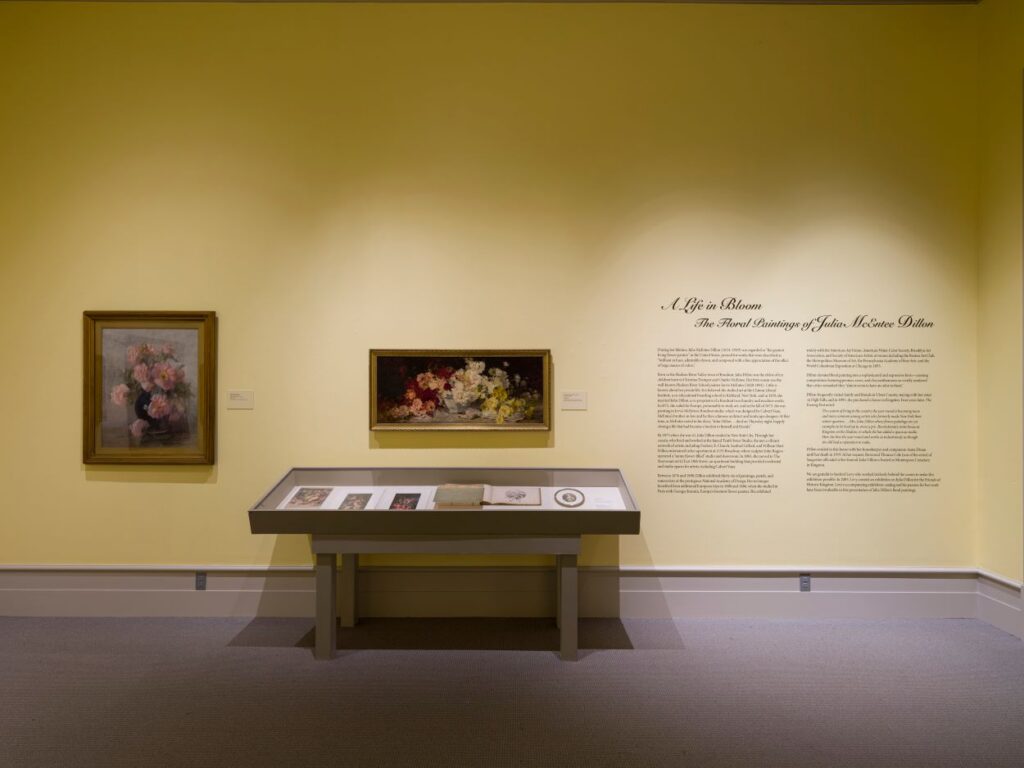
Despite the critical acclaim she garnered in her lifetime, we don’t know much about her private life. Scholars believe she studied art at the Clinton Liberal Institute. Her extended family offered her some exposure to the world of professional artistry. Her first cousin Jervis McEntee was a well-known painter of the Hudson River School. Jervis’ brother-in-law Calvert Vaux was a successful architect and landscape designer.
A Life in Art
Happily, more facts are available to us about Julia McEntee Dillon’s professional life than about her personal life. Between 1876 and 1890, she exhibited 36 paintings, pastels and watercolors at the prestigious National Academy of Design. She traveled to Europe in 1880 and 1886, when she studied in Paris with flower painter Georges Jeannin.

Within the United States, where she lived in the state of New York—first in Rondout, then New York City, and finally Kingston—Dillon exhibited widely. She showed her work with the American Art Union, the American Water Color Society, and the Brooklyn Art Association. Dillon participated in Society of American Artist displays at such venues as the Boston Art Club, the Metropolitan Museum of Art, the Pennsylvania Academy of Fine Arts, and the 1893 World Columbian Exposition in Chicago.
Paintings and objects on display
A Life in Bloom: The Floral Paintings of Julia McEntee Dillon occupies two rooms on the museum’s second floor. In the first room, visitors encounter seven paintings by the artist, as well as framed black-and-white photographs of her studio. A glassed-in display case presents a photo of Dillon, publications relevant to her career (such as an exhibition catalog, and also a copy of The Artist’s Year, to which Dillon contributed), and color reproductions of two of her flower paintings.
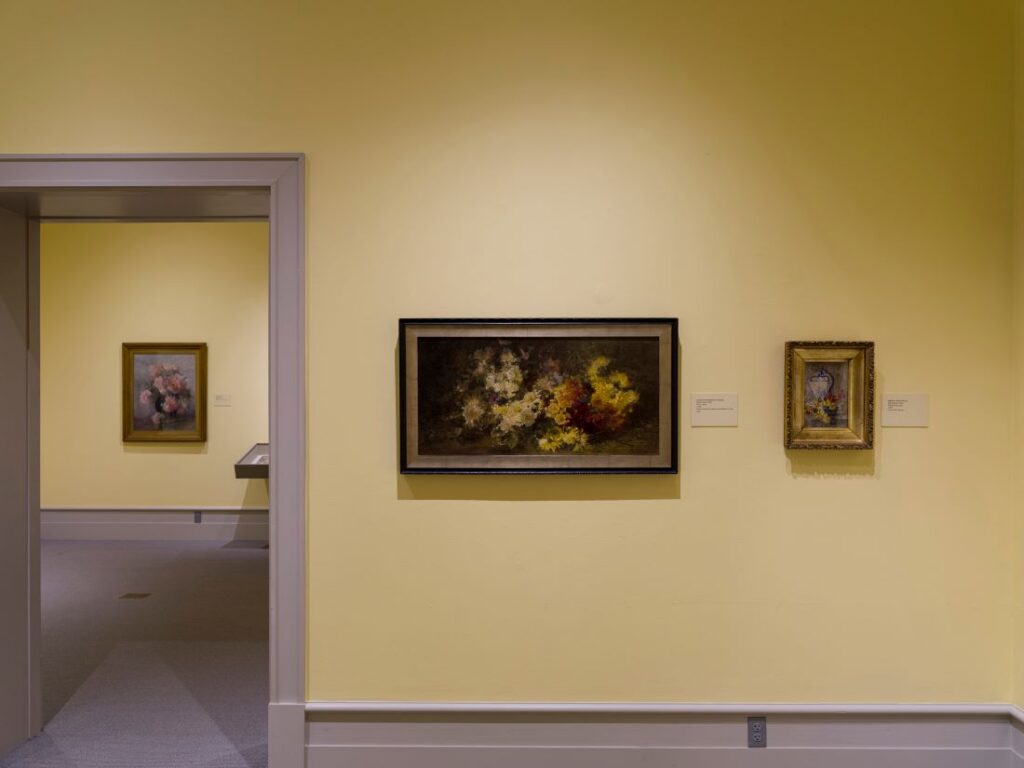
The second, larger room contains 22 floral still life paintings. The artworks vary considerably in size, from large to tiny. Several of the paintings stand out for their unusually long and narrow format (whether vertical or horizontal).
The walls of both rooms are painted a delicate shade of yellow, perfectly suited as a backdrop for the artworks. The position of the paintings on the walls is low enough that all viewers—including children—are able to see and appreciate the details of Dillon’s vividly rendered roses, chrysanthemums, peonies, and other flowers.
“The greatest living flower painter”
During her lifetime, her contemporaries regarded Julia McEntee Dillon as “the greatest living flower painter” in the United States. They described her work as “brilliant in hues, admirably drawn, and composed with a fine appreciation of the effect of large masses of colors.” With this show, the museum offers visitors rare access to the lifework of a talented, but underrecognized, American artist.
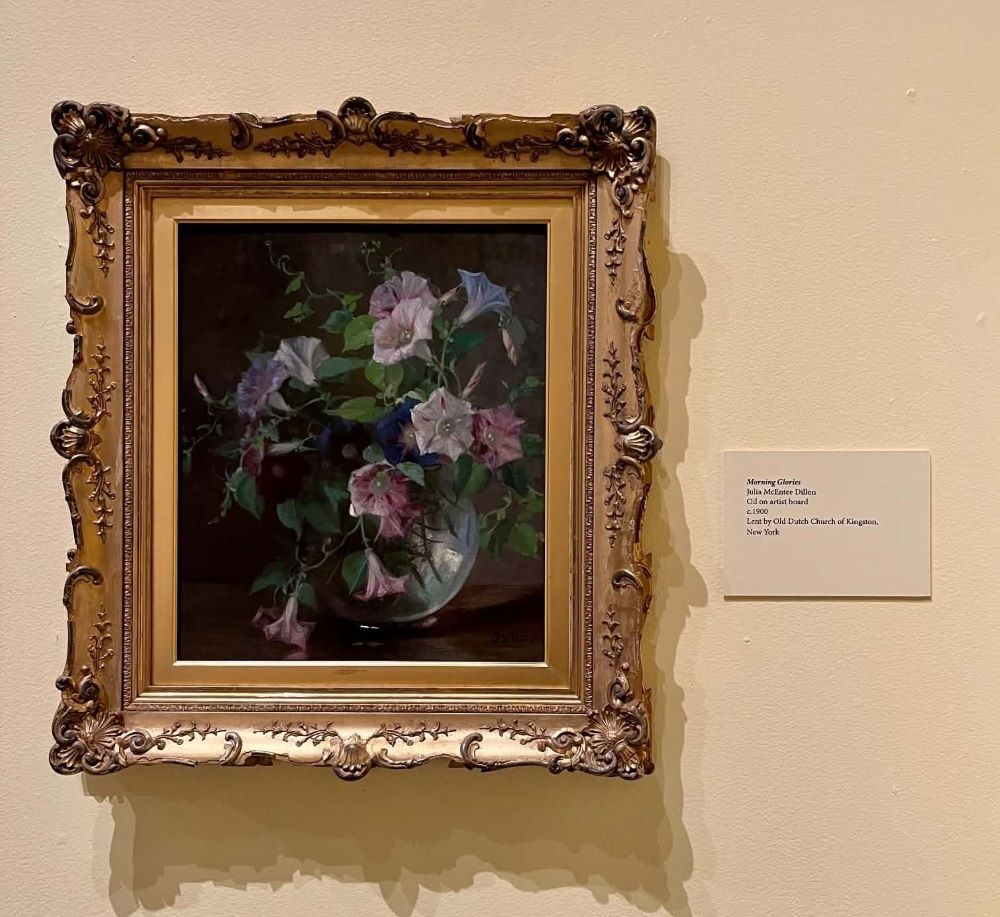
A Life in Bloom: The Floral Paintings of Julia McEntee Dillon is on view at the Albany Institute of History and Art through July 26, 2026.
Blanche Lazzell
Born and raised in Maidsville, West Virginia, Blanche Lazzell didn’t fit the stereotype of the modern artist. As the exhibition brochure states, “You could not find her in bars late at night, writing manifestos in Paris, or engaged in distracting affairs.” Determined and disciplined, and despite her challenges with her hearing, this intrepid woman secured for herself first a college degree—in 1905, at the age of 27—and then an art education.

Maidsville / Morgantown, Paris, New York, Provincetown
From 1907 to 1908, Blanche Lazzell attended the Art Students League in New York City. She returned to West Virginia for a time, then spent most of 1912 and 1913 touring Europe and studying art in Paris. She traveled to Provincetown, Massachusetts, for the first time in 1915. A few years later, in 1918, she established her permanent studio there. Lazzell would effectively spend her career migrating between Provincetown and Morgantown, West Virginia.
The multi-talented Lazzell was not only a painter, but also a designer and a printer. (For a time, she even supported herself by selling hand-painted china. And her practice extended to fiber art: she designed and hooked rugs.) She became a leading practitioner of white-line color woodblock printmaking. Influenced by the new movements of Fauvism and Cubism, Lazzell created some of the first non-objective prints and paintings to be seen in America.

Today, dozens of museums throughout the United States hold Lazzell prints and paintings. Among public institutions, the Art Museum at West Virginia University is the custodian of the largest collection of her work. The Smithsonian’s Archives of American Art is the repository of Blanche Lazzell’s papers.
Paintings, prints, and woodblocks
Blanche Lazzell: Becoming an American Modernist features about 60 paintings and prints, displayed through four rooms. On a wall in the second room, a 9-minute documentary about Lazzell’s life and work runs on a constant loop. We are grateful to museum guard Dan Coombs for the helpful suggestion to view the film first, as context for the exhibition experience.
With wall texts in both English and Spanish, the show’s related sections illuminate Lazzell’s winding paths through abstraction, realism, process, and media. These segments build an artistic context around Lazzell’s abstractions of the 1920s, and demonstrate the centrality of these paintings to her professional career and personal trajectory.

Though all of the paintings are framed, not all are behind glass. The absence of glass renders the texture of the artworks especially palpable. The viewer could be forgiven, in some cases, for momentarily mistaking a painting for a work of fiber art.
In addition to prints and paintings, the organizers include a couple of actual woodblocks that Lazzell used to make prints. The blocks, which still retain some of the color the artist applied, hang adjacent to related artworks. The juxtaposition gives visitors some insight into Lazzell’s process, and also into experimentation as an important aspect of her practice.
“It will be my own…”
Focused and disciplined, Blanche Lazzell was a pioneer among American artists of the early twentieth century. In a 1944 letter to a friend she wrote of her art, “It will be my own or it will be nothing.” This statement exemplifies the ambition and determination with which she pursued her calling. Blanche Lazzell: Becoming an American Modernist shines a light on Lazzell’s considerable contributions to American art.

Collateral
- Nestled in an alcove within the Blanche Lazzell exhibition, don’t miss the focused display of Silence, a painting by Samantha Littlefield Huntley (1864–1949), an Albany-area native. The Albany Institute of History and Art acquired this artwork in 2024. The mini-display includes the painting itself; a placard about it and the artist; and some black-and-white photos to do with the history of the work.
- The museum offers two free guides to the Blanche Lazzell exhibition—a beautifully produced 16-page print brochure, and a digital guide through Bloomberg Connects. The latter provides extended information about the works on view, addressing artist background, historical context, and insights into Lazzell’s techniques and process. Viewers can access this digital guide on site or remotely; it includes the Blanche Lazzell documentary we mention above.
- The organizers have thoughtfully provided a large magnetic “Make Your Own Abstract Artwork” board. Visitors can rearrange a variety of colorful magnetized shapes to create their own abstract work of art.
Blanche Lazzell: Becoming an American Modernist is on view at the Albany Institute of History and Art through August 2, 2026. The show travels in Fall 2026 to The Art Museum at West Virginia University. Its previous venues include the Academy Art Museum, The Bruce Museum, and the Provincetown Art Association and Museum.
Erika Gaffney is Founder of Art Herstory. Follow Erika on Bluesky, LinkedIn and Facebook.
More Art Herstory posts you might enjoy
Meet Susan H. Bradley, Trailblazing Watercolor Artist, by Andrea Sluder West
The Floral Art of Emily Cole, by Erika Gaffney
Women Artists from Savannah at the Telfair Academy Museum, by Julie Allen
Women Artists at the Cape Ann Museum, by Erika Gaffney
Susie M. Barstow: Redefining the Hudson River School, by Nancy Siegel
Laura Seymour Hasbrouck, A Painter of the Hudson River School, by Lili Ott
Visual Feasts: The Art of Sarah Mapps Douglass, by Erika Piola
Celebrating Eliza Pratt Greatorex, an Irish-American Artist, by Katherine Manthorne
The Ongoing Revival of Matilda Browne, American Impressionist, by Alexandra Kiely
Illuminating Sarah Cole, by Kristen Marchetti
Defining Moments: Mary Cassatt and Helen McNicoll in 1913, by Julie Nash
Women Reframe American Landscape at the Thomas Cole National Historic Site, by Erika Gaffney
Portraying May Alcott Nieriker, by Julia Dabbs