Guest post by Kristin Bluemel, Monmouth University
Agnes Miller Parker (1895–1980) is one of twentieth-century Britain’s most reclusive and most impactful woman artists. She specialized in the print art of wood engraving, which she joined to the commercial business of book publication in order to produce exquisite black and white illustrations in books for children and adults. These illustrations were created far from urban centers, often in circumstances of deprivation and outright oppression. They represent the drama of modernity as it was experienced and interpreted by a woman artist who chose to live and work in some of Britain’s greenest, most remote corners. Through her devotion to the illumination promised by imprinting white lines from blackened blocks, Miller Parker and her wood engravings bring together materials, personalities, geographies, and technologies that challenge conventional understandings of who and what counts in modern art.
Steel on Wood
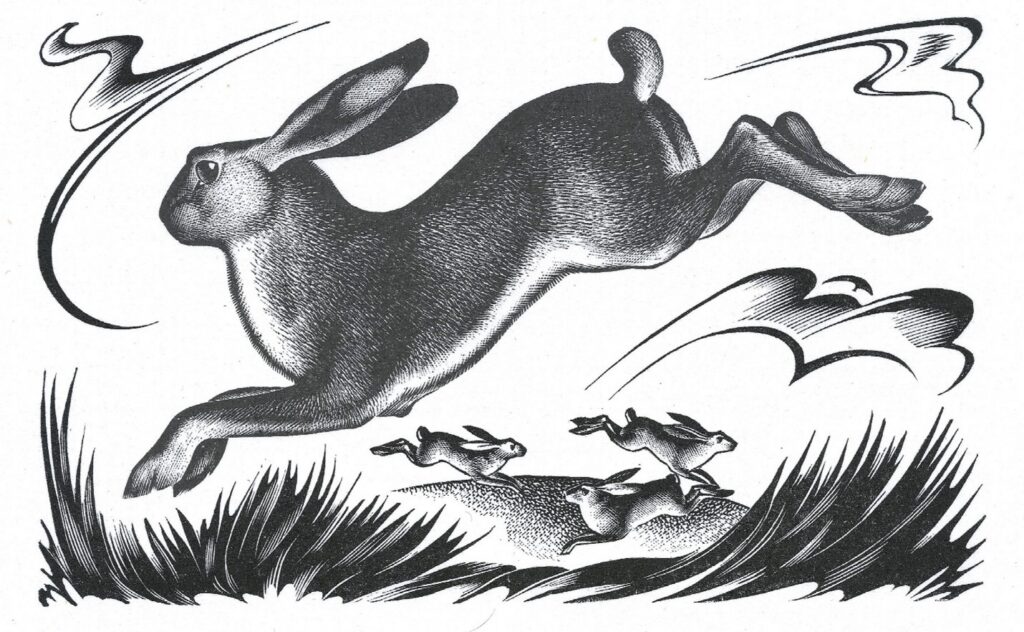
Xylography is the proper name for the art that Miller Parker practiced. Experts distinguish between woodcuts, which are made with a knife carving along the grain of a soft plank of wood, and wood engravings, which are made with steel engraving tools working upon the end grain of a small hardwood block. The images produced by impressing engraved and inked woodblocks upon paper typically appear as white lines shining through black ink, creating tones of grey and silver through illusions of line and light.
A Female Bewick
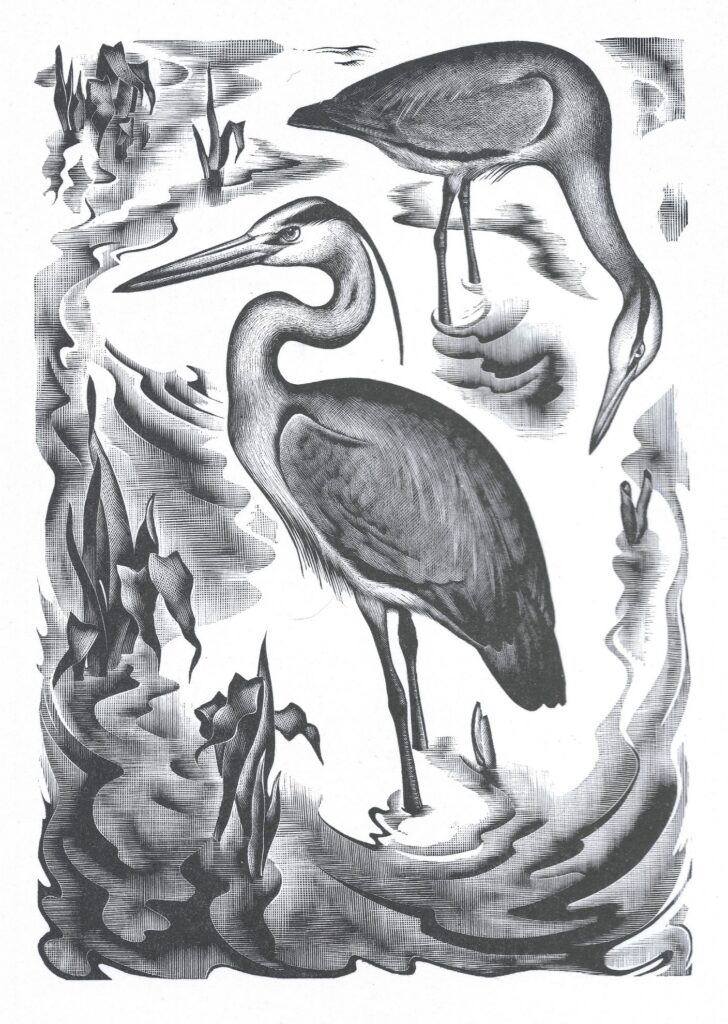
In her predilection for realistic scenes of country life, as in her adoption of white line wood engraving technique, Miller Parker turned aside from the decorative wood engraving tradition associated with nineteenth-century fine presses. This was the kind of wood engraving popularized most successfully in Victorian Britain by William Morris. Miller Parker chose instead a wood engraving method and style laid down 100 years earlier by the roughhewn, hardworking, North country artist, naturalist, and print innovator Thomas Bewick. Like Bewick, Miller Parker loved the countryside. Like him, she strove to abstract countryside scenes into lines on wood. And like him, she yearned to be the people’s wood engraver, creating pictures of natural beauty in rural Britain that common readers and ordinary children could encounter in books meant for kitchen tables and window seats, not rare book rooms or collectors’ libraries.
Art for the Masses
Miller Parker did not begin her career as the people’s wood engraver. In the 1920s she contributed wood engravings to expensive limited fine press editions that made art critics swoon. Yet impressing the critics did not release the culturally transformative power of her art. This had to wait until the mid-1930s, when she started accepting illustrative commissions from trade publishers who were eager to feed the public’s hunger for nature books illustrated with the “natural” art of wood engraving. Miller Parker’s illustrations for their books confirmed in the public’s imagination associations between her modern art and the forms of Bewick’s white line wood engravings of country life in eighteenth-century England. Her small, shimmering wood engravings of native birds, beasts, and habitats had the effect of “elevating” into art any mass reproduced, mass marketed book in which they appeared.
Glasgow to London to Rural Wales
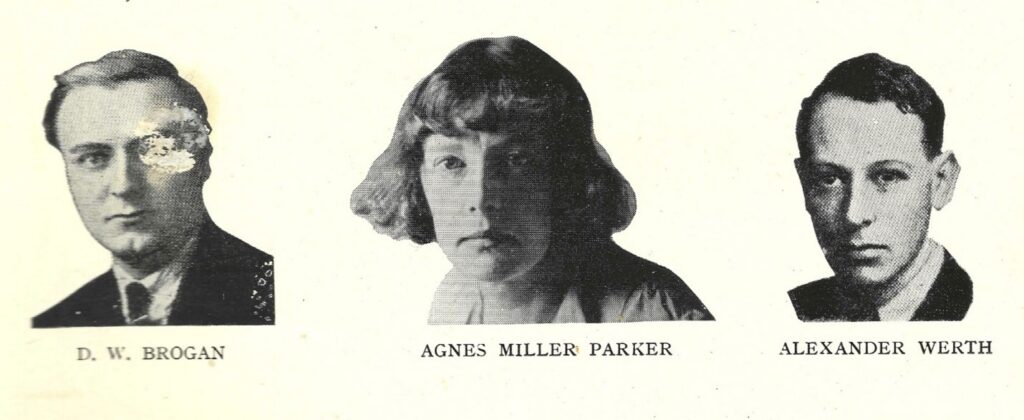
Miller Parker was born in Irvine, North Ayrshire, Scotland, the oldest of eight children of a middle-class couple with standard bourgeois Victorian expectations for their daughter. While they supported her formal art education at the Glasgow School of Art, they were only brought to tolerate, not approve, of her marriage in 1918 to fellow artist and conscientious objector, William McCance. The young Miller Parker and her husband left Glasgow for bohemian Hammersmith and by 1925 had won a disguised mention in a Daily Chronicle article as “the clever couple from Scotland who believe in cubist methods.”

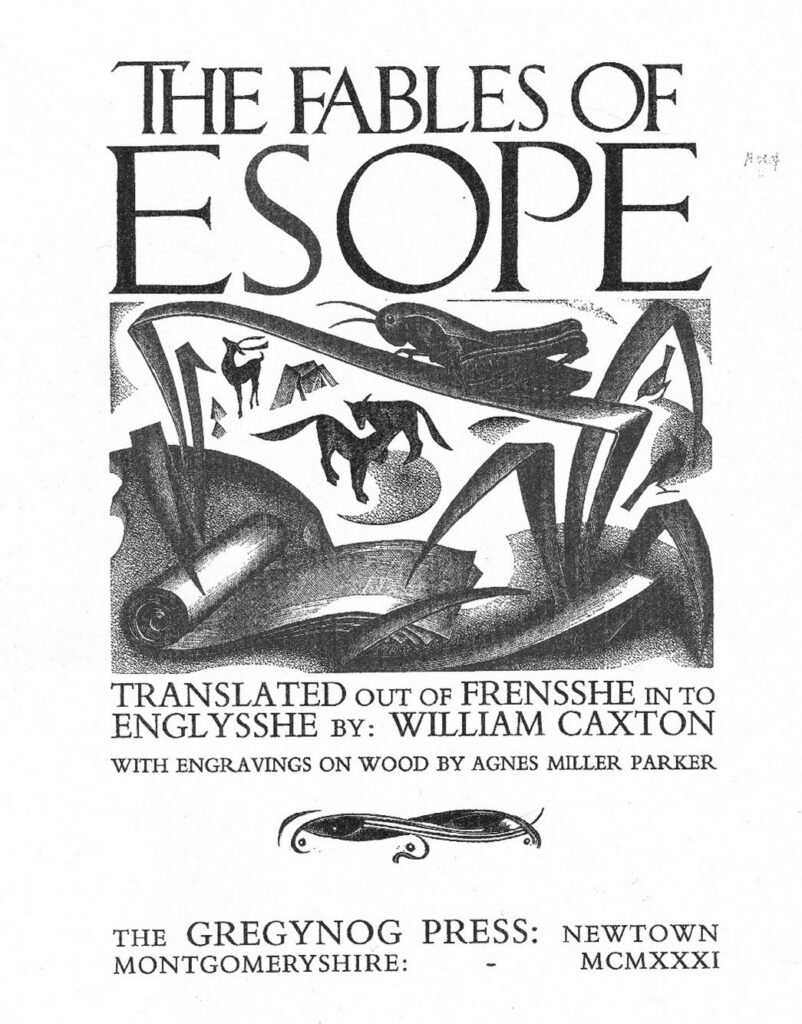
In 1930, during the depths of the Great Depression, Miller Parker and her husband left urban England for rural Wales. They were drawn by the opportunity to design and publish fine books for the private Gregynog Press. The Press was owned by the philanthropic Davies sisters, inheritors of a vast fortune generated by the South Wales coal fields. Miller Parker as illustrator and McCance as controller were together responsible for one of the most beautiful limited editions of the wood engraving revival, The Fables of Esope published by Gregynog in 1931.
The “Colour” of Wood Engraving
Miller Parker’s most devoted and astute critic, Ian Rogerson, praises her Gregynog work for its ability to “express native colour and an affinity with the modern English landscape with spontaneous enjoyment.” For those unfamiliar with the techniques and terminology of printing, these words may not make much sense. What could it mean to describe a black and white wood engraving as expressing “colour” or find in the lines of Miller Parker’s geometric designs an “affinity with the modern English landscape”? By “colour” in wood engravings, Rogerson means that Miller Parker could produce with her tools and blocks, black ink and white paper, unusually vibrant and varied illusions of grey tones. He recognizes that Miller Parker’s techniques advanced what print historian Richard Benson describes in The Printed Picture as one of the central problems in the technological development of printing: “How do you describe gray when your ink is black?”
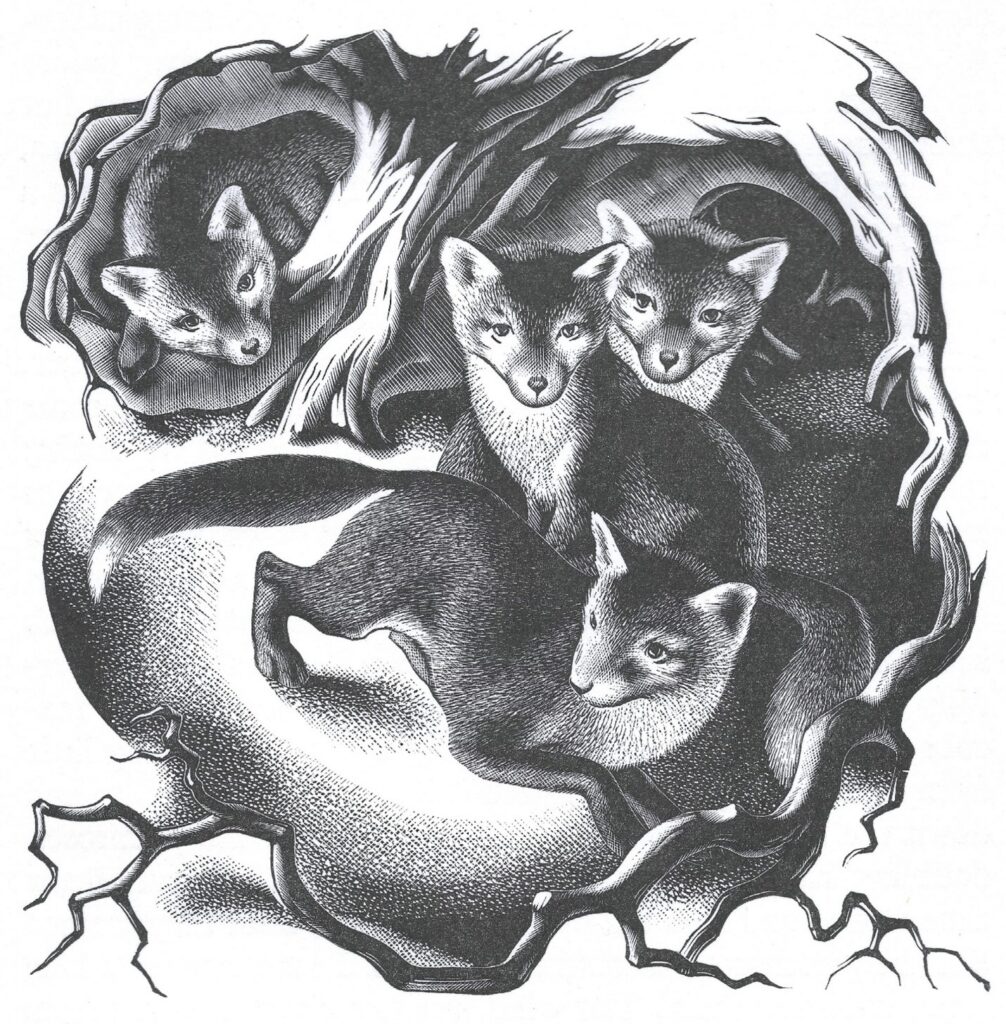
The solution, discovered centuries ago by intaglio engravers like Albrecht Durer, is to create groups of closely arranged black lines. If these are viewed from a short distance away, “the eye blends the lines and spaces to read variable tone.” While other wood engravers active during the mid-century revival, including women artists Gwen Raverat, Joan Hassall, Clare Leighton, and Gertrude Hermes, were also skilled at creating illusions of variations of tone, none did so with as much effect on popular imaginings of the animals and environments of rural Britain as Agnes Miller Parker.
Wind-mills and Woodlands
In 1933 Miller Parker moved with her husband McCance, her cats, spitstickers, burins, and tint tools, into an abandoned wind-mill in Albrighton, Shropshire. While there, contending with resident doves, lack of heat, and a wandering husband, Miller Parker earned what was in retrospect to serve as her most important commission. In 1935, Victor Gollancz asked if she would be interested in contributing to his series of countryside books illustrated in black and white wood engravings. The first book in the series, Clare Leighton’s Four Hedges: A Gardener’s Chronicle (1935), had been extremely popular. Its texts and images appealed to a reading public that seemed to have an insatiable appetite for books on country living and scenes of rural life.

Due to its high-quality commercial printing and relatively low sales price, Miller Parker’s first book for Gollancz, Through the Woods: The English Woodland—April to April (1936), with a commissioned text by the popular regional novelist and Country Life journalist H. E. Bates, was equally successful. Print historians agree that Through the Woods was instrumental in creating a public awareness of the compelling effects and multiplied pleasures of reading texts with wood-engraved illustrations.
White Lines, Black Blocks, Rural Modernity
Wood engraving is a form of relief printing, which means that each engraved line or speck left by the artist’s tool on the block appears white once run through a press. The black of Miller Parker’s wind-mill is the inky reminder of the original raised wood surface of her block. It is the shape and the meaning that emerges from the surface she has not engraved. This technique of leaving white lines on black ink background requires the artist to visualize her subject in terms of lights rather than darks. It is the inverse approach of intaglio printing which requires the artist to anticipate a black line wherever her hand has carved the copper.

Like Impressionist painting, which is also known for its experiments with representing outdoor light, wood engraving lent itself to outdoor subjects. During the interwar wood engraving revival in Britain, there were so many expert practitioners choosing to represent outdoor scenes in this medium, that wood engraving itself became associated with nature, with animals, and with the rural spaces of the nation and the national imaginary.
Freedom by the Sea
In 1955, after decades of living in rural places far from her publishers, art markets, and urban booksellers, Miller Parker made a radical bid for freedom. In the company of her brothers, she ran away to Glasgow, seeking to escape a husband who had become increasingly controlling and abusive. A 1958 article in The Bulletin newspaper quotes Miller Parker from Riddrie, a northeastern corner of Glasgow, as saying, “I am looking for a house in the country, or by the sea. . . I’d like to live on an island best of all.” She eventually found her island, Arran in the Firth of Clyde. With it, she found happiness as a single woman working, fishing, sailing, and swimming. Wood engraving allowed her to accomplish what relatively few women in human history have been able to achieve: independent life as a professional artist.
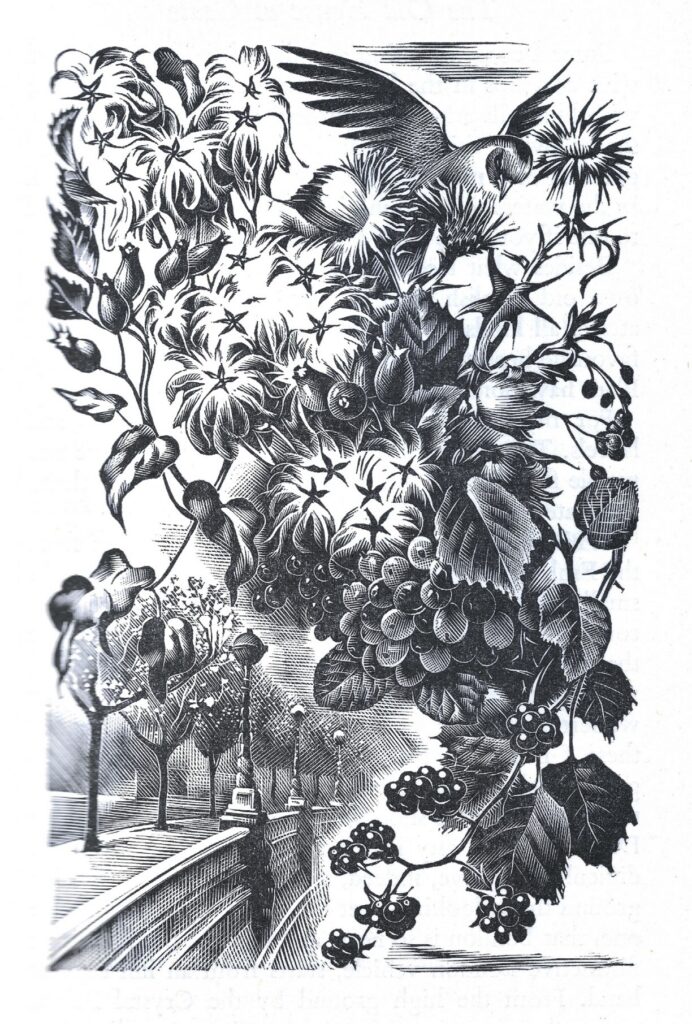
It also allowed her to turn the grim tale of women’s gendered fear and domestic oppression into what might seem a fairy tale ending of tranquillity and beauty in rural Britain. We can detect in this story two kinds of strong magic that animate all of Miller Parker’s books. On the one hand, we feel the binding force of Victorian and Edwardian women’s devotion to husband and marriage amid literally unutterable shame. On the other hand, we feel the liberating force of modern women’s rebellion from convention and expectation amid unprecedented opportunities for gendered self-recreation in a postwar world.
The People’s Wood Engraver
A book illustrator who cared about the whole process of book making and book reading, Miller Parker is an important British artist fully engaged with her modern world. Her art led her from urban to rural homes and her art sustained her in these rural homes. Ultimately, her art allowed her to break free from these rural homes once they had become prisons. It is a curious turn of artistic fate that decidedly traditional white line wood engraving, Thomas Bewick’s kind of wood engraving, could facilitate this proto-feminist transformation. In adopting and adapting Bewick’s techniques and rural subjects, and in choosing to share her art through illustration in affordable books, Miller Parker took up Bewick’s role as the people’s wood engraver. She heroically shaped her modern woman’s life in rural British places, seeking in countryside scenes inspiration for her unique black and white interpretations of nature’s ideal forms.

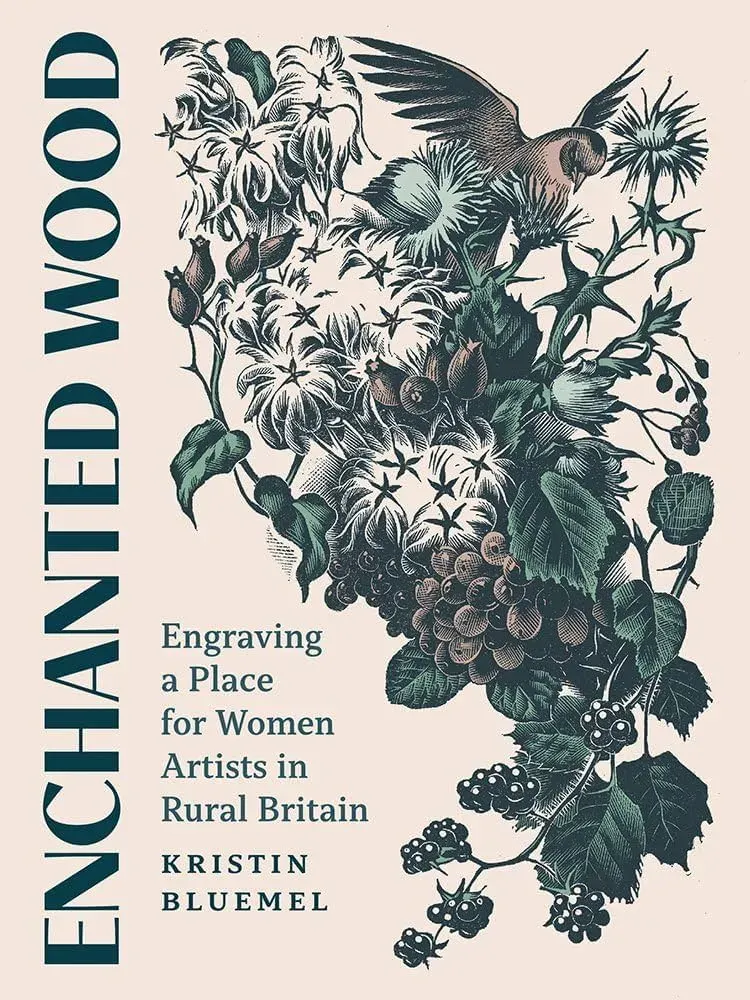
Kristin Bluemel is author of Enchanted Wood: Engraving a Place for Women Artists in Rural Britain (with support of the Leonard A. Lauder Research Center for Modern Art, The Met). She is Professor of English and the Wayne D. McMurray and Helen Bennett Endowed Chair in the Humanities at Monmouth University. In 2022, she joined Newcastle University as a Leverhulme Visiting Professor, doing research in Thomas Bewick’s hometown of Newcastle, England. She is the author or editor of books and articles on British modernism, intermodernism, illustration, print history, and children’s literature.
Other Art Herstory blog posts you might enjoy:
Nancy Sharp: An Undeservedly Forgotten Exemplar of Modern British Painting, by Christopher Fauske
Women Artists from Savannah at the Telfair Academy Museum, by Julie Allen
Sculpture or Suffrage: Alice Morgan Wright, by Jennifer Dasal
Reflections on the Audacious Art Activist and Trailblazer Augusta Savage, by Sandy Rattley
A Quiet Eye—The Unique Achievement of Sylvia Shaw Judson, by Rowena Loverance
Minnie Jane Hardman | An Introduction, by Hannah Lyons
The Life and Art of Dorothea Tanning, by Victoria Carruthers
Modern Women Artists in Copenhagen 2024–2025: Three Exhibitions, by Alice M. Rudy Price
The Cheerful Abstractions of Alma Thomas, by Alexandra Kiely
Deirdre Burnett: A Significant British Ceramic Artist Remembered, by Jo Lloyd
Dalla Husband’s Contribution to Atelier 17, by Silvano Levy