Guest post by Gurpreet Sihat, art writer
The history of Mughal painting is usually told through the names of great male artists. But look closer, and a small group of women emerge from the spaces between them.
The seventeenth-century Muraqqa-e-Gulshan, an imperial album compiled for Prince Salim (later Emperor Jahangir), contains around 300 paintings by some of the greatest Mughal artists. While the majority are attributed to male artists, and a substantial number remain unattributed, several have been attributed to women: Ruqaya Banu, Nuri Nadira Bano, Nini, and, according to some modern scholars, Khurshid Banu, though the evidence remains unclear.
But of all the female artists in the Mughal court, one stands out beyond the others: Sahifa Banu.
Who was Sahifa Banu?
Experts know almost nothing about her life. She lived in the early seventeenth century, though we don’t know the exact dates, or even years, of her birth and death. We do not know where Sahifa Banu was born, who trained her, or even her exact social status. It is likely she belonged to the Mughal royal family or aristocracy. Manuscript painting required years of specialized training and access to imperial workshops, which were tightly restricted. Furthermore, most women’s artistic activity occurred within the zenana, a political, cultural, and economic centre for women, run by women: a city within a city that included libraries, schools, and mosques, while also patronising artists, participating in trade, and commissioning architecture. It would make sense for Sahifa Banu to fit within this landscape.
Despite the silence surrounding her life, Sahifa Banu’s name and artwork survive. Through them, we can glimpse a female artist working at the height of Mughal culture during the reign of Emperor Jahangir, during an important shift in Mughal art. Influenced heavily by Empress Nur Jahan, themes involving women became increasingly popular. Jahangir’s artistic commissions shifted away from large narrative manuscripts toward intimate album paintings designed for private enjoyment rather than public display. Portraiture flourished. Naturalism became more refined, inspired partly by European engravings entering the Mughal court through trade and diplomacy. Artists experimented with perspective, shading, and observation of the natural world.
Sahifa Banu’s work reflects all of this.
She modified earlier Persian compositions, altered spatial depth, experimented with perspective, and introduced Mughal naturalism into inherited traditions. Her paintings combined Persian aesthetics, Indian visual sensibilities, Sufi symbolism, and traces of European artistic influence.
Sadly, only three paintings are confidently attributed to her:
- Shah Tahmasp
- The Son Who Mourned His Father
- The Building of the Castle of Khawarnaq
Shah Tahmasp
Shah Tahmasp, now in the Victoria and Albert Museum in London, combines portraiture, poetry, calligraphy, and illumination into a single luxury object. Tahmasp I was the second Safavid ruler of Iran, reigning from 1524 to 1576. He fought prolonged wars against Suleiman the Magnificent and the Ottoman Empire.
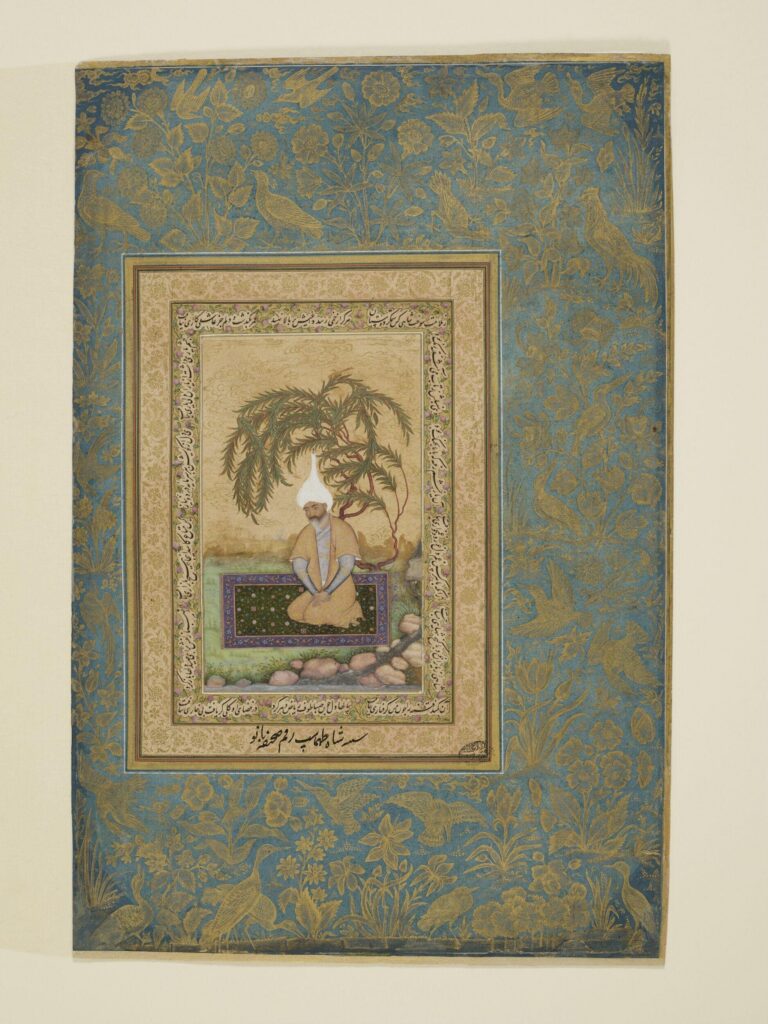
The miniature adapts an earlier portrait painted around 1540 by the Persian master Agha Mirak of the School of Behzad. Yet Sahifa Banu transforms the image into something uniquely her own. Rather than emphasizing kingship and power, Sahifa Banu presents Shah Tahmasp almost like a Sufi mystic or ascetic scholar. The bending tree shelters him like a spiritual canopy, while the rocks and garden setting create a space poised between wilderness and paradise.
The Shah himself sits on a Persian carpet beneath a bending tree beside a stream. His white turban, composed of layers of muslin wrapped around a sharply conical cap, reflects the fashionable Safavid style of the Tahmasp-Behzad period. He appears humble, seated barefoot, wrapped in a simple ochre robe, his eyes downcast.
Sahifa Banu intentionally ignores strict linear perspective. The carpet appears oddly tilted, following the conventions of Persian miniature painting, where decorative clarity mattered more than realism.
Around the image is a breathtaking blue-and-gold border painted with birds, flowers, vines, and animal life. The borders are believed to have been painted by Mansur, while the illuminated mount may have been executed by Daulat, another master court artist.
On the reverse is an illuminated panel containing verses from Omar Khayyam:
O thou, who hast surely listened to many a story,
Listen for once to that of the potter.
The potter for years and months seeks
To make the earth of others into pots.
When he himself is dead and his body changed and veiled into earth,
others will make pots out of him.
The poem reflects on mortality and the transformation of the body back into earth, themes echoed visually throughout the miniature. The painting becomes less a royal portrait than an aesthetic meditation on spirituality, contemplation, and detachment from worldly life.
The Son Who Mourned His Father
Another extraordinary work by Sahifa Banu belongs to the Aga Khan Museum: The Son Who Mourned His Father.
The painting illustrates a scene from Mantiq al-Tair (The Conference of the Birds), the famous Persian Sufi poem by Farid ud-Din Attar. In the poem, a group of birds (each representing a human weakness preventing spiritual enlightenment) are led by the hoopoe, a symbol of wisdom, through seven mystical valleys in search of the Simorgh. Throughout the journey, the birds hear spiritual anecdotes and parables, with their worldly attachments, ego, fear, and illusions gradually stripped away through each story. The Son Who Mourned His Father is one of these tales.
At first glance, the miniature appears to depict an ordinary social scene. But once the narrative is understood, every figure becomes charged with meaning.
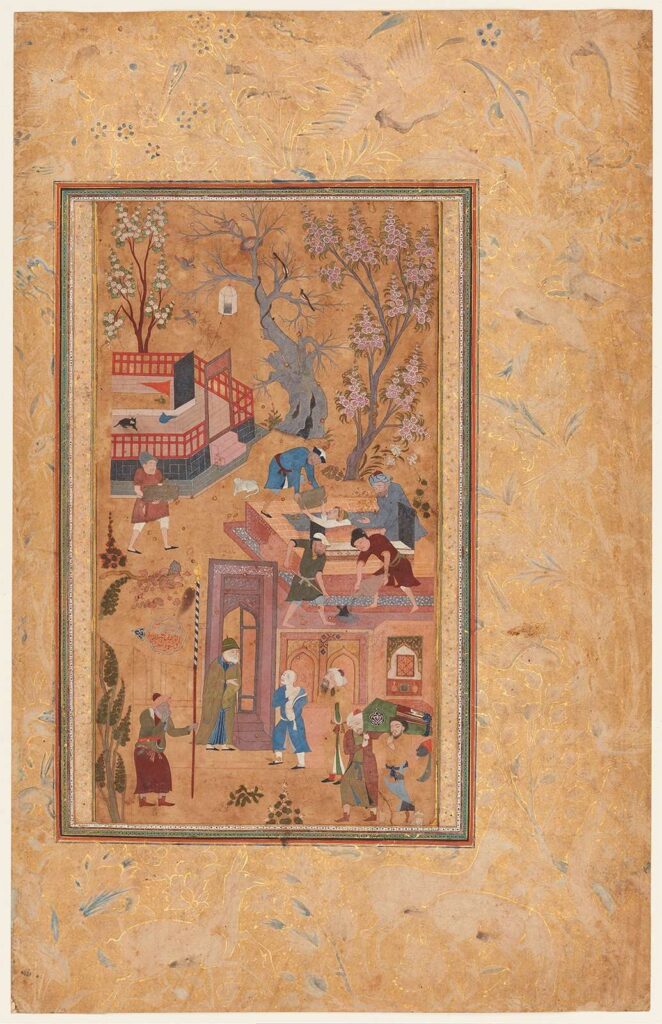
The composition should be read upwards, starting at the bottom with a grieving son walking behind his father’s coffin. The son becomes the emotional centre of the work. He follows his father physically but emotionally remains trapped between attachment and acceptance. His movement through the gate symbolizes a crossing from ordinary life into the ritual world of death.
Along the path, he meets a Sufi who offers him consolation, reminding him that no one can escape death. His words express a central Sufi belief: the impermanence of worldly existence. In Sufi thought, grief must ultimately lead toward understanding, acceptance, and preparation for the soul’s return to God.
Next, we follow them to the funeral ceremony in the centre. Finally, at the top, the most symbolically important detail appears: a bird flying toward the white cage suspended from the tree. In Persian mystical literature, birds often symbolize the soul. Here, the bird represents spiritual ascent and liberation from the body, as well as the poem to which the story belongs. The cage, though usually associated with imprisonment, instead becomes a threshold between worlds, neither earthly nor heavenly, but suspended between them. The tree itself acts as a cosmic bridge: its roots grounded in earth, while its branches extend upward towards heaven.
This miniature transforms a funeral scene into a meditation on mortality, grief, and transcendence. It compresses grief, ritual, consolation, and spiritual transcendence into a single composition, unfolding almost like poetry across the page.
The Building of the Castle of Khawarnaq
The third known painting attributed to Sahifa Banu is The Building of the Castle of Khawarnaq, now held in the Golestan Palace Library.
The work illustrates a story from Nizami’s Khamsa (Five Treasures), one of the most influential literary texts in Persianate culture and a favourite subject for illustrated manuscripts across Persian, Turkic, and Mughal courts. The Castle of Khawarnaq was described in Arabic-Islamic literature as one of the wonders of the world.
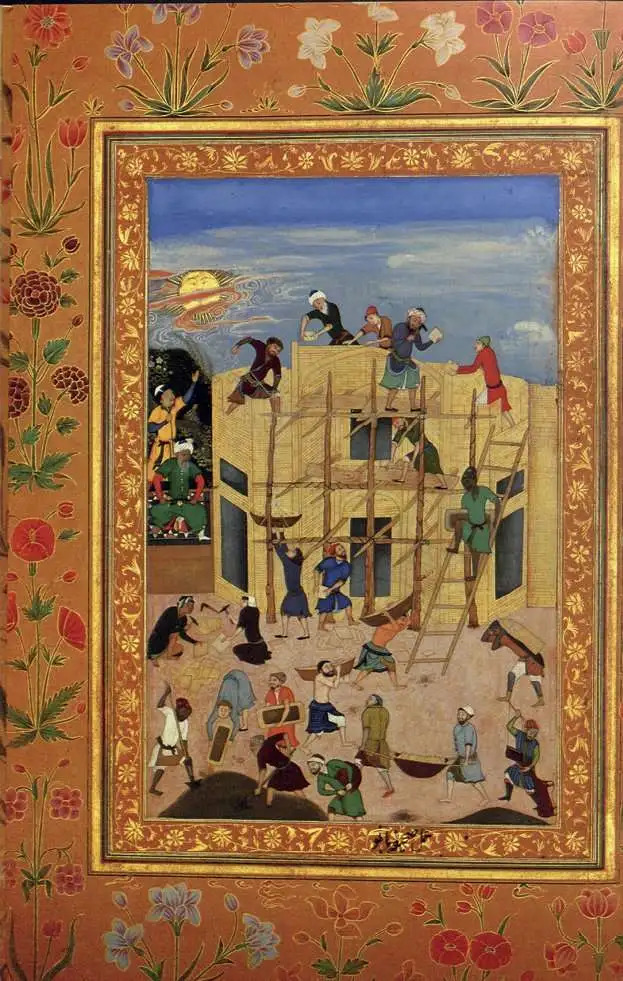
Although difficult to access today, scholars note that the painting demonstrates Sahifa Banu’s sophisticated understanding of European artistic techniques, especially in spatial depth and perspective. Like her other works, it also shows her engagement with earlier Persian masters such as Kamal ud-Din Behzad, while simultaneously reshaping those traditions through Mughal visual language.
A Woman Emerging from Silence
Sahifa Banu matters not simply because she was a female painter, but because her surviving miniatures reveal intellectual depth, literary sophistication, symbolic subtlety, and technical mastery rarely referenced in connection to a woman of this period.
Her work challenges the old assumption that Mughal painting was an exclusively male world. It also raises difficult questions about how many unnamed women may have contributed to manuscripts, albums, borders, and workshops without ever receiving attribution.
Today, we possess only fragments: a name, a few paintings, scattered references. But the silence surrounding Sahifa Banu is itself historically revealing. It speaks to gender, artistic authorship, and historical memory in the Mughal world. Perhaps one day we will discover that the substantial number of paintings that remain unattributed in the Muraqqa-e-Gulshan are also the work of women’s hands.
For now, through these luminous miniatures, Sahifa Banu briefly emerges from that silence.
Gurpreet Sihat is a London-based content writer and tutor with a passion for history and art. Follow her on Instagram at Stories from the Art; read about other historic artists on her blog.
More Art Herstory blog posts you might enjoy
Portrayals of Mary Magdalene by Early Modern Women Artists, by Diane Apostolos-Cappadona
Exhibiting Artemisia Gentileschi; From the Connoisseur’s Collection to the Global Museum Blockbuster, by Christopher R. Marshall
Plautilla Bricci (1616–1705): A Talented Woman Architect in Baroque Rome, by Consuelo Lollobrigida
Suor Orsola Maddalena Caccia (1596–1676), Convent Artist, by Angela Ghirardi
Female Solidarity in Paintings of Judith and her Maidservant by Italian Women Artists, by Sivan Maoz
Mary Beale (1633–1699) and the Hubris of Transcription, by Helen Draper
Elisabetta Sirani of Bologna (1638–1665), by Adelina Modesti