Guest post by Suzanne Karr Schmidt, Newberry Library and Theresa Kutasz Christensen, Art Gallery of Ontario
Think Renaissance and Baroque prints were only ever produced on paper? Think again! For many the term “Old Master Print” may automatically conjure an image of paper saturated with dark ink. In that context, names like Rembrandt or Dürer are virtually synonymous with the medium. Contrary to this common construct, some of the most innovative and experimental premodern printmakers, book publishers, and engravers used silk and linen in their printing practice. Many of the makers, as well as the users, of these prints on fabric were women.
With funding through the Getty Paper Project and organization by the Newberry Library, print and fabric scholars from around the world met in Chicago in 2024. They studied the global phenomenon of engravings, woodcuts, and other print media on fabric from the beginning of printmaking in the fifteenth century up to the present. The exciting result is the upcoming Newberry Library exhibition Impressive Textiles: Printing on Fabric, opening December 10, 2026. The accompanying catalogue, available in print and open access, was authored by thirty experts and offers a starting point for more research.
What Are We Missing?
Despite decades in their respective fields, many of the project contributors had never previously considered combining these important media. This led to a collaborative and interrogative process which often bought up more questions than answers. Throughout the production of Impressive Textiles numerous queries related to the medium, its practitioners, and its uses were raised. Among them were questions of what we know about women’s contributions. What did they create? What did they consume? Why don’t we know more?
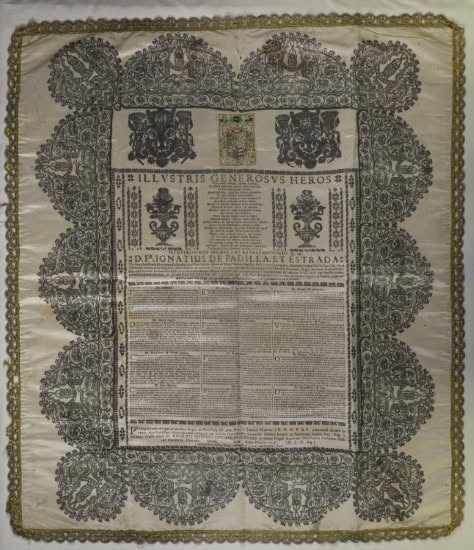
Compounding scholarly blind spots is a survivor bias wherein the medium was prone to use in small, luxury editions which have not survived due to scarcity. They were also used in domestic goods where their utility has decreased the likelihood of survival and institutional stewardship. In other words, we don’t know what we don’t know. One spectacular example published by a woman, a large-scale silk satin thesis print published by Manuela Cerezo in 1746 Puebla, Mexico, is so complex that it inspired two exhibition catalogue chapters. Yet it remains the only example she printed on fabric that has survived. (Fig. 1)
While the essays in the catalogue illuminate many object types, as a museum exhibition it can only represent those works which are extant and that can be displayed to the public. We take this post as an opportunity to address the issues of survivor bias and material experimentation relating to women’s contributions in the medium through a deeper look at fabric works by the artist, Magdalena de Passe (Dutch, 1600–1638) most of which no longer exist.
Magdalena’s Origin Story
Although her name appears on fourteen different pages throughout the Impressive Textiles catalogue, most of de Passe’s fabric output no longer survives. Therefore, her footprint in the exhibition itself is not as strong as we might have hoped given the fascinating nature of her contributions in the medium. Ilya Veldman and Nadine Orenstein have written about de Passe, and Veldman has provided a particularly insightful biographic summary in the online Digital Lexicon of Netherlandish Women.
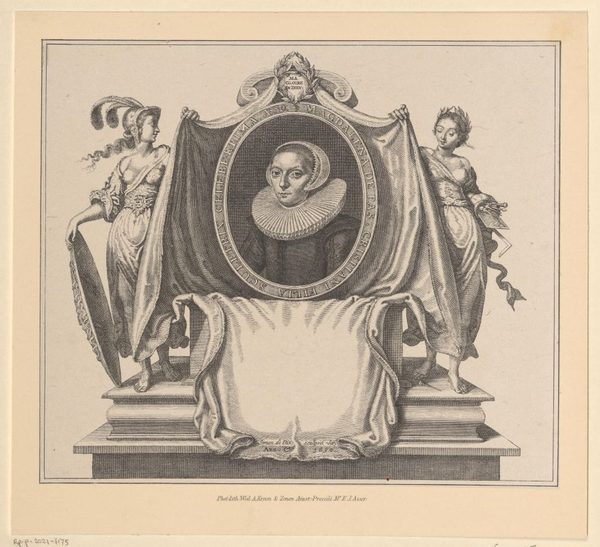
Magdalena’s engraving career began as part of a family of printmakers, including her father Crispijn de Passe I, and three brothers. A portrait engraving by her brother Simon, in 1630 (Fig. 2), refers to her as “celebrated,” quite possibly due to her start as a child prodigy. Of all the family members, she began engraving the earliest, at age fourteen. She created a variety of landscapes, mythological subjects and portraits in her short career. 1630 was also the first year Magdalena approached the governing body of the States General for official approval of her plans to offer prints on fabric. These included fifteen designs for men’s caps, about which we will say more below.
Her Early Engravings
Magdalena’s earliest signed work was an engraving after a Marten van Heemskerck drawing of the Great Pyramids, part of a 1614 series on the Seven Wonders of the World. Her signature does not appear on all of her prints, as was common in a family workshop setting, but when it does, it can bear additional meaning.
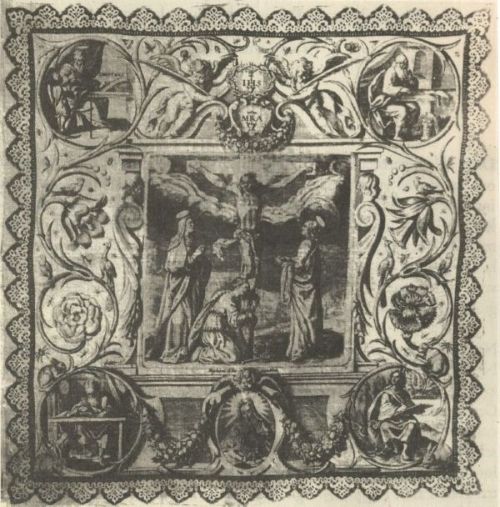
For instance, in her one surviving print on fabric, a linen chalice veil used during Communion with a central Crucifixion scene, the artist has signed her full name, “Magdalena de Pas.” (Fig. 3) The word Magdalena appears just under the despondent figure of Mary Magdalene, who is kneeling at the base of the cross and embracing it, while the Latin verb for engraved, “sculpsit” appears on the other side. This emphasis suggests a seemingly Catholic partiality toward the saint or at least a recognition of her namesake. However, as Magdalena’s Mennonite father had moved the family to Cologne from Antwerp and then to Protestant Utrecht to avoid religious persecution, it is difficult to read too much into the association.
Magdalena’s Early Artistic Circle
Beyond her prolific engraver family, Magdalena was well known to other artists and poets including Hendrick Goudt, Jacob Cats, and the painter Adrian van de Venne. The latter penned an ode in honor of her praiseworthy artistic accomplishments in copper engraving. First published in 1623, and again in 1633, the poem was perhaps written even earlier given that he repeatedly refers to her as a Jonck-Vrou, or young lady, in a way that implies more than a polite form of address for an unmarried woman. Interestingly, he also wrote an ode to her competitor, Willem Jacobsz. Delff, who frequently printed his own portraits on satin for the inspection of the States General. (Fig. 4)

Van de Venne implies that Magdalena’s skill and verve with the burin has created something innovative, but he unfortunately does not say what. Perhaps she was already printing on fabric by 1623?:
“You, young lady, whose steel tool
Van Passe knows so skillfully,
Creates something new in copper.
Please accept now this poem, for your art,
With which you have honored me;
I find it good, honorable, and favorable
That I have completed my apprenticeship.”
(Approximate translation thanks to Jacquelyn N. Coutré, Art Institute of Chicago)
Magdalena Later in Life
Actively seeking out paintings to reproduce and dedicating her prints to other creatives, Magdalena married a fellow artist around 1633, at which point she seems to have stopped engraving. Unlike fellow women artists like Manuela Cerezo, who took over her deceased husband’s press and ran it successfully for forty years, Magdalena never returned to printing. Instead, she returned home to care for her father when her spouse died unexpectedly. Crispijn de Passe I died in 1637, and Magdalena would herself pass away prematurely in 1638.
The truncation of the careers of women artists due to familial obligation or early death due to illness or childbirth often led to smaller oeuvres, diminished posthumous name recognition, and lower numbers of securely attributed works. Freedom for material or artistic experimentation often came only with security and establishment of a successful career, additionally limiting the number of surviving works which illustrate early modern women’s professional ingenuity. Magdalena’s greatest printing innovation was the one we have never seen, as it was made to be worn—and worn out—but it might be possible to reconstruct it.
Magdalena’s Printed Night Caps
According to extensive archival research by Nadine Orenstein, in 1630 Magdalena received an exclusive right for three years to print “portraits on linen canvas and other materials.” Due to the labor-intensity of textile production, cloth was much more expensive than paper. The serviceable and washable linen Magdalena used was part of the early modern clothing and furnishing fabric cycle. It was usually worn to shreds and then sold to be recycled as paper fiber. While only the chalice veil mentioned above survives today, we know Magdalena printed at least fifteen designs for men’s caps. Usually called night or sleeping caps, these were frequently worn around the home, if not necessarily to bed.
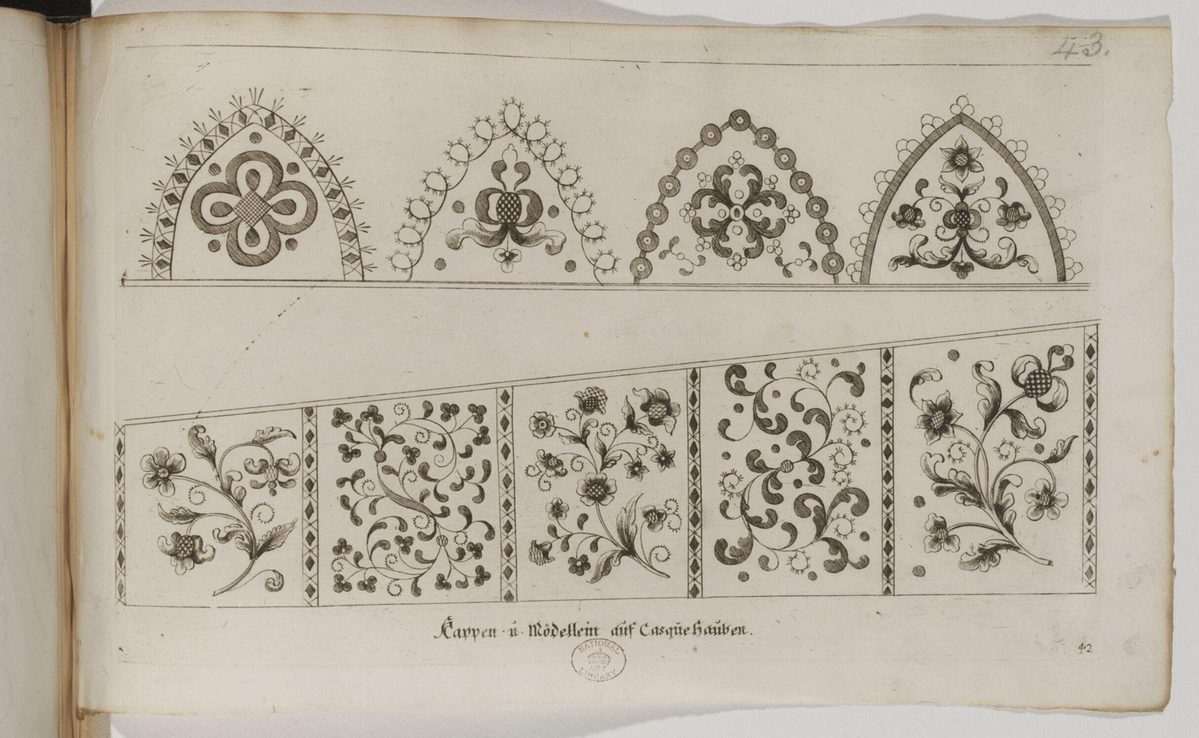
In 1631 Magdalena brought examples before the States General of her night caps for inspection. The archive noted their subject matter. The structure was likely similar to other European caps, and an eighteenth-century print of a similar decorative embroidery template survives from the German artist Margaretha Helm. (Fig. 5) At the top it shows the four compartments that would have been sewn together to form a rounded cover to the main band. (This elongated gore-shaped format found in both clothing and printed globes.) (Fig. 6) But we still don’t know who would have put the caps together: the purchaser? Or would Magdalena have paid seamstresses to construct them for sale? Or at least for demonstration to the States General? We need more research into the intersection of printers and textile guilds.
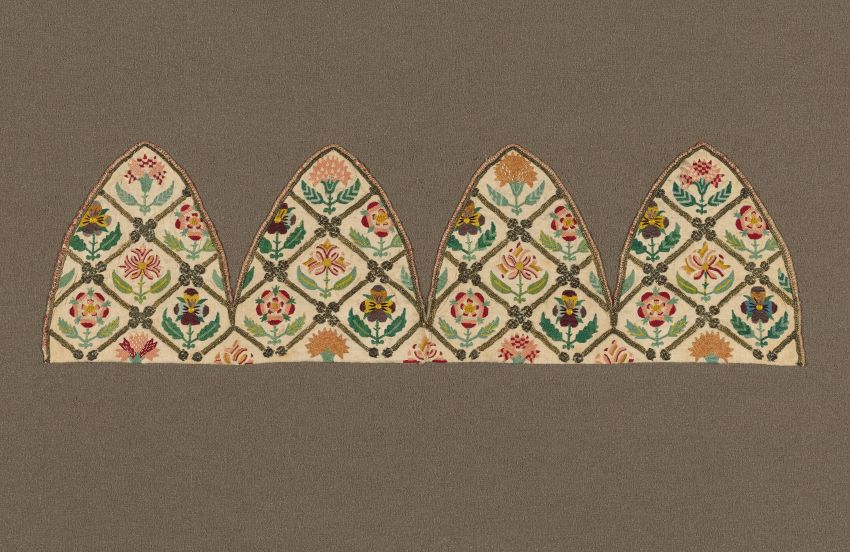
One piece of evidence suggests that the purchaser may have been the intended constructor of the cap. In much the same way, a book buyer would have had to have their pages bound. The chalice veil does not appear to be hemmed with actual lace, leaving only the printed suggestion of it at the fragile edges. Were wealthy women the intended purchasers of Magdalena’s caps? We do know that printed fabric embroidery templates enjoyed some popularity as luxury versions of paper templates like Helm’s, so Magdalena may have targeted a similar market for the production of domestic textiles. Many night caps were meant to be embroidered; however, the pictorial nature of the imagery on Magdalena’s caps gives one pause when considering those possibilities.
Reconstructing Her Shepherdess Cap
Magdalena’s lost cap imagery included allegorical topics similar to those populating her landscapes. These included a quartet of shepherds or shepherdesses in roundels, the Four Elements, and Four Times of Day (Morning, Afternoon, Evening, Night). All of them would fit neatly in the top of a cap. She also offered current political topics including a depiction of a successful sea battle against the Spanish, and numerous portraits of noble Protestant sympathizers. She dedicated several of those to the then incredibly popular King Gustavus Adolphus of Sweden (1594–1632).
In this respect Magdalena was well ahead of her time. Later printed accessories took advantage of similar fervors, such as inaugural waistcoats celebrating the Holy Roman Emperor Leopold II made in 1790. There were even portraits of the Marquis de Lafayette printed on kid gloves and silk sashes worn by women to his parades throughout the East Coast of the United States during his 1824–25 Farewell Tour.
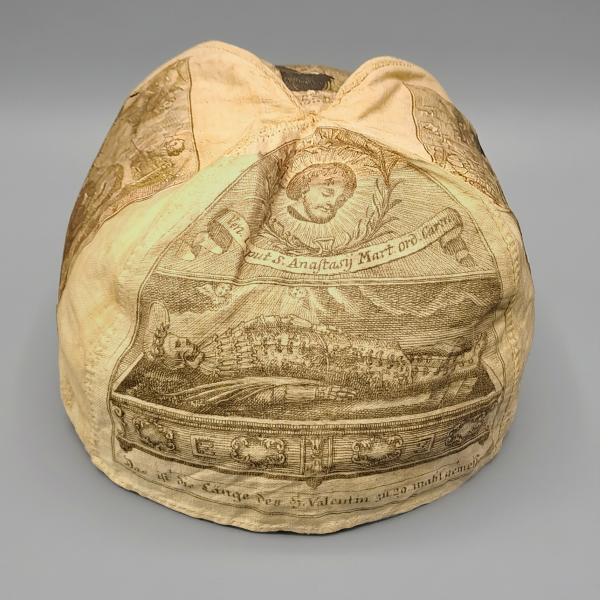
There is very little published literature on printed night caps as an object type and only a handful of extant examples are known to us as of the publication of this essay. The closest surviving comparative examples appear to be the medical-devotional category of the Fraisenhaube, a bonnet or cap meant to prevent infant seizures. Extant examples in Austrian collections demonstrate a four-part construction similar to the top of the Helm design. They feature the Virgin Mary, the Christ Child, and Saints, like Anastasius and a Saint Valentine who were known to heal head injuries and epilepsy. (Fig. 7) These caps seem to utilize extant printing plates, not bespoke imagery, and do not appear to have been embroidered, reinforcing the idea that Magdalena’s printed image would have been appreciated as a final stage of the artwork rather than as an intermediary template.
From Design to Wearable Print
Magdalena produced at least one printed series on paper of the Four Seasons, and her father engraved one of the Four Times of Day. Yet nothing in their known oeuvres appears to have been directly transferrable for re-use within the restricted geometric areas of the cap template structure. Nevertheless, in an attempt to visualize Magdelena’s lost caps we have produced a tentative reconstruction of the shepherdess cap. It adapts images from Magdalena’s undated Spring and Summer engravings, as well as a book of shepherdesses published in 1640 by her brother Simon said to include a covert posthumous portrait of her (at center left). (Fig. 8)
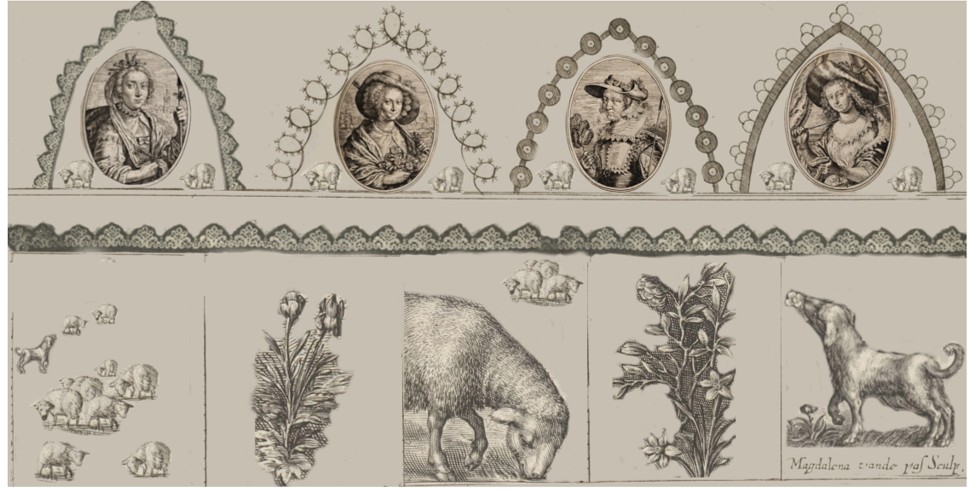
Digital image, 2026. Print size 38.6 × 76.2 cm (15 2/10 × 30 in.).
The act of producing this speculative replica and constructing it gave us the opportunity to study the engraver’s making process in depth. We also used it to consider how that data might inform our understanding of her final product and its evolution and sale post-printing. (Fig. 9)
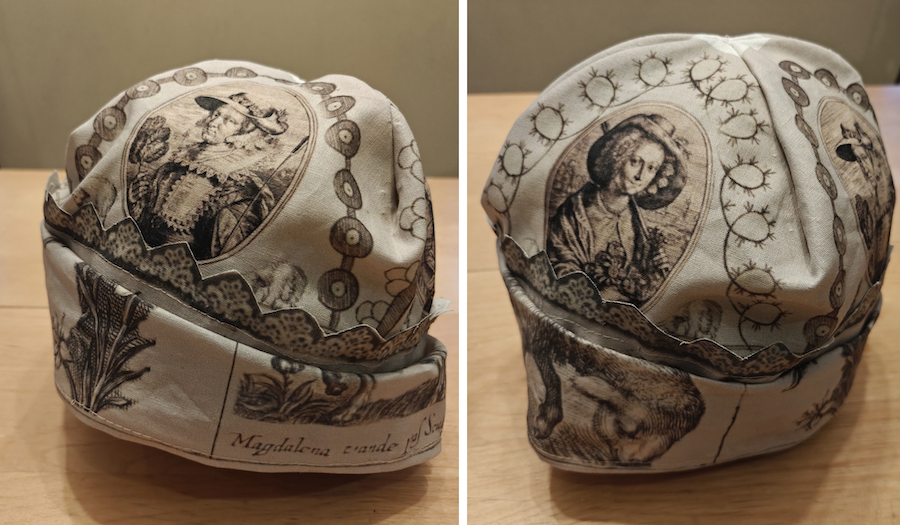
We hope it also might help readers expand their concepts of women’s innovative artistic outputs and encourage specialists to review their collections in search of comparable works which might further our knowledge of this object type. Given the prominence of Magdalena’s signature on the Crucifixion in the chalice veil, it seems likely that she would have signed her night cap compositions prominently, perhaps at the bottom of the main band encircling the man’s head. Happily, should one ever reappear, this pride in her accomplishments should aid in identifying it.
Conclusions
In working to address these broad gaps in our understanding of early modern women’s fabric printing, we aimed to identify both specific examples as well as object types to better situate prints on fabric within the artistic, social, political, religious, and domestic spheres in which they were created. We found that many of the ways in which prints on fabric as a medium have broadly escaped critical inquiry closely mirror those museological and scholarly mechanisms. These have long obscured the depth and breadth of historic women’s artistic output on a greater scale. Women’s work, including but not limited to prints on fabric, often falls between curatorial departments and academic specializations. Discoverability is limited by both the fragility and light sensitive nature of the materials—thereby prohibiting its sustained display—as well as the inability of standard museum database fields to facilitate their identification.
While the Newberry’s exhibition could not include prints on fabric that no longer exist, Impressive Textiles: Printing on Fabric does include a printed chalice veil that was clearly inspired by de Passe family prints and Magdalena’s own fabric output. The show and its accompanying catalogue intend to reignite the conversation about these overlooked artworks and their many female makers.
Author bios
Suzanne Karr Schmidt is the George Amos Poole III Curator of Rare Books and Manuscripts at Chicago’s Newberry Library. She works on the materiality and use of prints and books and is the editor of Impressive Textiles: Premodern Printing on Fabric and curator of the exhibition. Other notable publications include her monograph Interactive and Sculptural Printmaking in the Renaissance (2018), and the exhibition catalogue Altered and Adorned: Using Renaissance Prints in Daily Life (Art Institute of Chicago, 2011). Other recent exhibitions at the Newberry include Renaissance Invention: Stradanus’s “Nova Reperta,” co-curated with Lia Markey in 2020, and Pop-Up Books Through the Ages in 2023. Suzanne can be found sharing her daily Newberry discoveries on Bluesky (@drkarrschmidt) and Instagram (@ladydisdaine).
Theresa Kutsaz Christensen is Assistant Curator of Provenance in European Art at the Art Gallery of Ontario in Toronto, Canada. She is an art historian specializing in women’s roles in the historical art market and provenance research. Most recently, she developed the inaugural course in provenance at the International Foundation for Art Research (IFAR) and served on the curatorial team for the award-winning 2023/24 catalogue and exhibition, Making Her Mark: A History of Women Artists in Europe 1400–1800, at the Baltimore Museum of Art and Art Gallery of Ontario. Her work has been supported by notable fellowships from the Fulbright Foundation, Kress Foundation, and the Getty Scholars Program. Tess can be found posting on art, architecture, and food on Instagram (@thetesstkitchen) and can also be contacted through LinkedIn.
Also by Suzanne Karr Schmidt
Material Re-Enchantments: A Review of Remedios Varo: Science Fictions
More Art Herstory posts about early modern women artists
Discovering Early Modern Women Artists in Iberia, by Cathy Hall-van den Elsen
Early Modern Women Artists at Auction in 2025, by Erika Gaffney
Historic Women Artists in Public Collections: The Kimbell Art Museum, by Olivia Turner
Portrayals of Mary Magdalene by Early Modern Women Artists, by Diane Apostolos-Cappadona
Early Modern European Women Artists at the Montreal Museum of Fine Arts, by Erika Gaffney
Two of a Kind: Giovanna Garzoni and Artemisia Gentileschi, by Mary D. Garrard
The Priceless Legacy of Artemisia Gentileschi: A Curator’s Perspective, by Judith W. Mann
Female Solidarity in Paintings of Judith and her Maidservant by Italian Women Artists, by Sivan Maoz
Plautilla Nelli and the Workshop of Santa Caterina in Cafaggio, by Alessia Motti