Thoughts on Michaelina Wautier: Painter at the Kunsthistorisches Museum in Vienna
Guest post by Allison van den Hoek, author of INDELICATE: Michaelina Wautier’s Untold Story
Within these walls covered with works by Michaelina Wautier, “the greatest artistic rediscovery of the century” (Artnet), the viewer will find the answer to this question: What if female painters of seventeenth-century Northern Europe had been given the same opportunities as men? Wet-in-wet brushstrokes—possibility within possibility—was the technique which Michaelina Wautier (c. 1614–1689) used to create her masterpiece The Triumph of Bacchus—a herculean feat for even the best male painters of her time.

Enter the main event at the Kunsthistorisches Museum: the Michaelina Wautier exhibition created by curators Gerlinde Gruber and Julien Domercq (Fig. 1, 3). It is only fitting that the premier of Wautier’s wide scale exhibition should be here in Vienna, like a flagpole claiming her stake in unmapped territory: female Old Masters.
It was the Archduke of Austria, Leopold Wilhelm, for whom Wautier had painted her Bacchus masterpiece. Archduke Leopold Wilhelm resided at Coudenberg Palace in Brussels during Wautier’s most prolific years and was perhaps the greatest collector of art in the seventeenth century. When he returned to Vienna, he took Wautier’s Triumph of Bacchus and her portraits of saints with him. Many of the Archduke’s paintings now form the Kunsthistorisches Museum’s (KHM) collection. But unlike the male artists from this collection, Wautier’s authorship became obscured through the alteration of her name in records and prejudices against her sex. And as Nathalie Pauwels, Exhibition Content Team at KMSKA Antwerp, recently said to me. ‘A Rubens painting always stayed a Rubens. But women artists’ works were often lost track of.’

Unhinging the Locked Door of Art History’s Bias
In 1993, more than three centuries after the creation of The Triumph of Bacchus, Katlijne Van der Stighelen would restore Wautier’s authorship of this work. Representatives of the KHM asked her to look at a Van Dyck in storage at the museum. During the Northern European Baroque period, painters often left their works unsigned. But with one glimpse of The Triumph of Bacchus, Van der Stighelen instantly recognized the hand of her beloved artist, Michaelina Wautier. Nobody believed Van der Stighelen at first. Yet, Wautier had also taken things a step further. It was clear, she had painted her own face on the Bacchante leading the procession (Fig. 3). The same eyes, nose, lips, cheeks, and chin were present on her self-portrait (Fig. 12).

In 1650s Northern Europe, it had seemed impossible for women to become master painters. They didn’t have access to the needed education and support, and in the rare instance of these opportunities, women artists were often restricted to still lifes. Yet, Wautier had the freedom of a brother painter, a more equal peer, as opposed to a father or a husband in the trade. Charles, Michaelina’s brother, older by five years, was a wide cloak behind which she could explore the fullest capacities of her art. Like Emily Dickinson, Wautier “dwelled in possibility”—something that only existed for women in dark hours as the world slumbered, or if they had access to A Room of One’s Own, according to Virginia Woolf. Behind Charles’ cloak, sexism and prejudices fell away for Wautier, sifting between gaps in floorboards. Step into the first room of the Kunsthistorisches Museum exhibition.
Biblical Scenes Brushed Anew
Michaelina Wautier invenit et fecit (Fig. 2) “Invented and created by Michaelina Wautier” shimmers across the long folds of a taupe drape. This is how Wautier signed only two of her works, her proudest accomplishments. The Education of the Virgin (Fig. 4) is the first of these: a heart-tugging image of the young Virgin as a girl being taught to read. In Wautier’s time only half the population could read. Clearly, she wanted to show that the future Mother of Jesus, as well as other girls, had the ability to learn and needed education. The Virgin as a girl, a person with her own history, is a rare depiction in Flemish art.

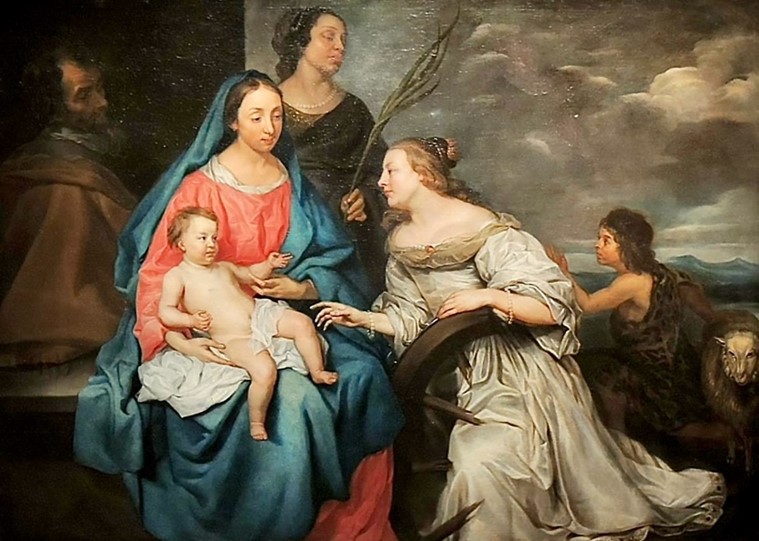
Opposite this is Wautier’s other invented work: The Mystic Marriage of St Catherine (Fig. 5). The painting depicts the jagged and splintered spokes of a failed wheel, the implement of Catherine’s torture to prove her devoutness, against the gleaming white of a wedding dress. This is unlike other renderings of this story, and more realistic. Wautier’s interpretation is not set in heaven, but in a stable. Jesus as an infant, is not physically presenting Catherine a wedding ring but giving her a divine look of acknowledgement. The angel with a palm frond in hand appears ordinary. Catherine’s face, full of compassion, is life-like. In this work and the Education of the Virgin, which Wautier signed as inventions, we find her ability to create relatable characters.
An Early Mary Cassatt
In Wautier’s paintings, The Education of the Virgin, Boy with a White Cravat (Fig. 6), Two Girls as Saint Agnes and Dorothy, Boys Blowing Bubbles, and The Five Senses, it’s clear that Wautier has an affinity like Mary Cassatt for drawing children (Fig. 7). Wautier’s children’s faces are imbued with curiosity, contemplation, and wonder.
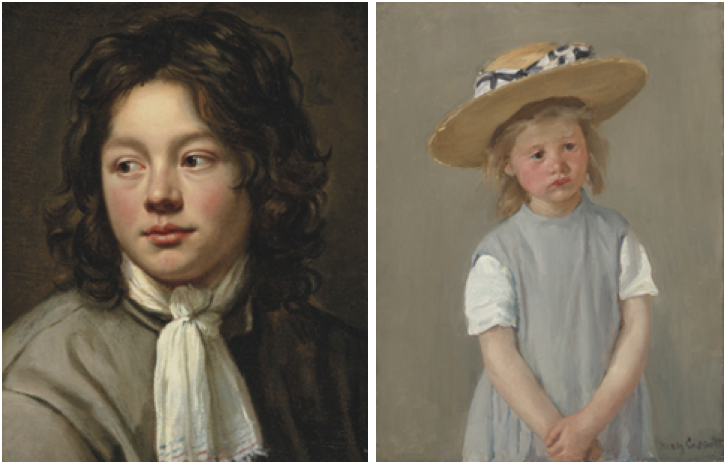
Fig. 7 (right): Child in a Straw Hat, c. 1886, by Mary Cassatt; National Gallery of Art
Capturing the Hearts of Commanders
The next room at the exhibition reveals personages from Wautier’s social background: a Spanish army commander, her brother Pierre a military commander, Jesuit priest Martini Martino, and the etching of Andrea Cantelmo, a Neapolitan artillery general. When she painted these works Coudenberg Palace—or “Cold Mountain Palace”—loomed over Brussels. It was one of the most beautiful royal residences of Europe and had a stunning entertainment hall, the Aula Magna. It is within this setting that Wautier dared to be as brave as her commanders by painting them. These men in turn let down their defenses, sometimes allowing her to capture their inmost selves.
Few paintings illustrate a deeper understanding between artist and model than Wautier’s Portrait of a Military Commander (Fig. 8). It is the Mona Lisa of Wautier’s works. The Commander’s gaze at her is penetrating. The viewer can literally feel his heart beating below his deep-rose colored sash, the highest rank of military commendation.

These men were not the only ones who Wautier captured with deepest expression. There were also Saint Joachim and Joseph, and the Biblical Jacob (Fig. 9), whom Wautier painted with stunning relatability. Wautier shows these men with their humility intact: faces marked with years, salted whiskers, and knowing eyes. The marked realness of Jacob is so intense, the viewer feels as if the man is present and waiting for a reply.
Trusting in Her Materials
Wautier’s hallmarks are present throughout this KHM exhibition. The realness of her figure’s faces, far from stoic, appear to be breathing and moving. Her characters have the finest strokes of hair, eyebrows, or beard. Each root, curl, or whisker is perfectly brushed. Their simple costumes are made of Venetian fabrics with a rope or a band cinching them at the waist. She painted those garments’ crinkles and folds to allow their textures to bring her scenes closer to life. Wautier’s luxurious fabrics and rare pigments came via Venice which was then an international hub of trade. To Wautier, Venice must have seemed a magical place from where gods were sending these glorious materials her way. In the same manner that sculptor Barbara Hepworth chiseled stone, Wautier appears to have brushed pigments as if her ideas were flowing from the materials themselves.

The Triumph of Bacchus, Wautier’s Act of Defiance
Wautier’s The Triumph of Bacchus (Fig. 10) is almost a parody on all other Bacchanals, most particularly Titian’s (Fig. 11) which hangs in London’s National Gallery and in copy behind the stage at Covent Garden’s Royal Opera house. Perhaps Wautier had seen this hundred-year-earlier version of this well-known work when she decided to create hers. In Titian’s version we see Ariadne swooning as Theseus sails off. Bacchus is the hero, a lithe cherub-like figure swooping down to rescue Ariadne. Wautier’s version has herself as Ariadne, bare-breasted and leading Bacchus’ entourage as he is ported along drunk in a wheelbarrow. Wautier also played with the symbolism in Titian’s Bacchus and Ariadne. In Titian’s work, the wine god is wearing a heroic deep-rose loincloth and his signature leopards stride prominently in the scene.
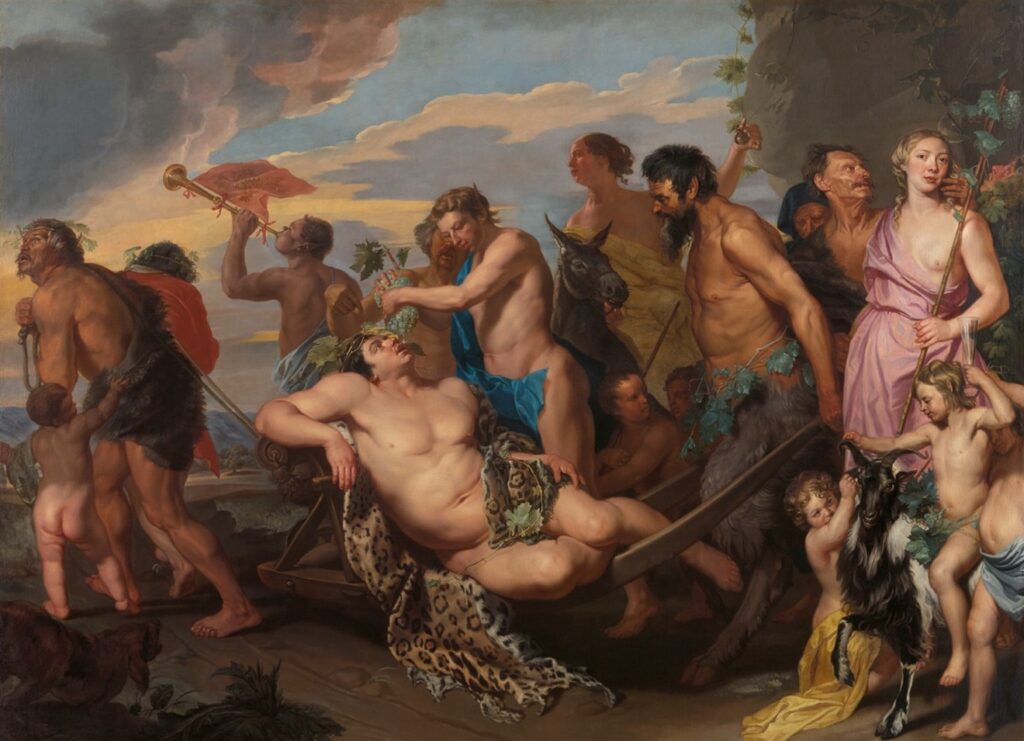
Yet in Wautier’s version, Ariadne is wearing the heroic deep-rose, and Bacchus’ leopards are only a skin covering his loins. Wautier was clearly a feminist with a sense of humor. She must have been smiling and thinking I’ll show them as she painted these elements. Including herself also in this image was beyond daring. It appears she purposely made her arms more muscled as she did not want to seem weak. Yet, the artistic liberties Wautier took are not the only wonders of this Bacchanal. Her creation of a work this size was a monumental feat. According to a recent Guardian article, The Triumph of Bacchus makes Wautier “the first known woman to have painted the nude male body on a life-size scale.”

Painting Herself as an Old Master
Near this masterpiece is Wautier’s self-portrait, in which she literally painted herself as an Old Master (Fig. 12). And even here she went one step beyond, breaking all societal bounds by opening her double lace collar to reveal a hint of breast. Her dauntless gaze into the viewer’s eye is confrontational, and demonstrative. See me now; I’m a woman who can paint and have the right to be an Old Master.

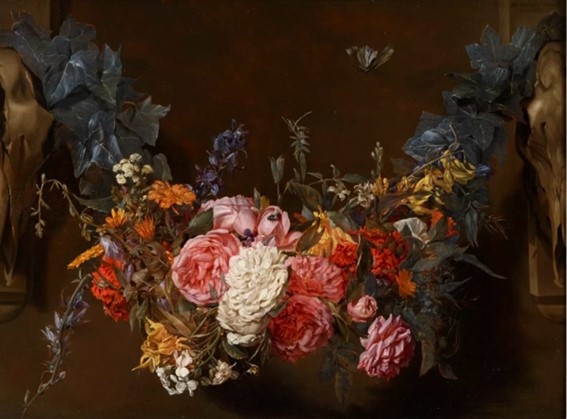
Even in her still life subjects, Wautier refused to be limited. She was the first woman to paint the skulls of animals—three centuries earlier than Georgia O’Keeffe. Her flower garlands (Fig. 13) deftly hang between skulls of sheep. This proves that Wautier had knowledge of not only mythology but also iconography. She knew how to use visual symbols to convey themes and stories. Her garlands are a display of life’s fragility: a reminder that we will die, so we must be pious.
A Room of Her Own—A Realm of Creative Freedom
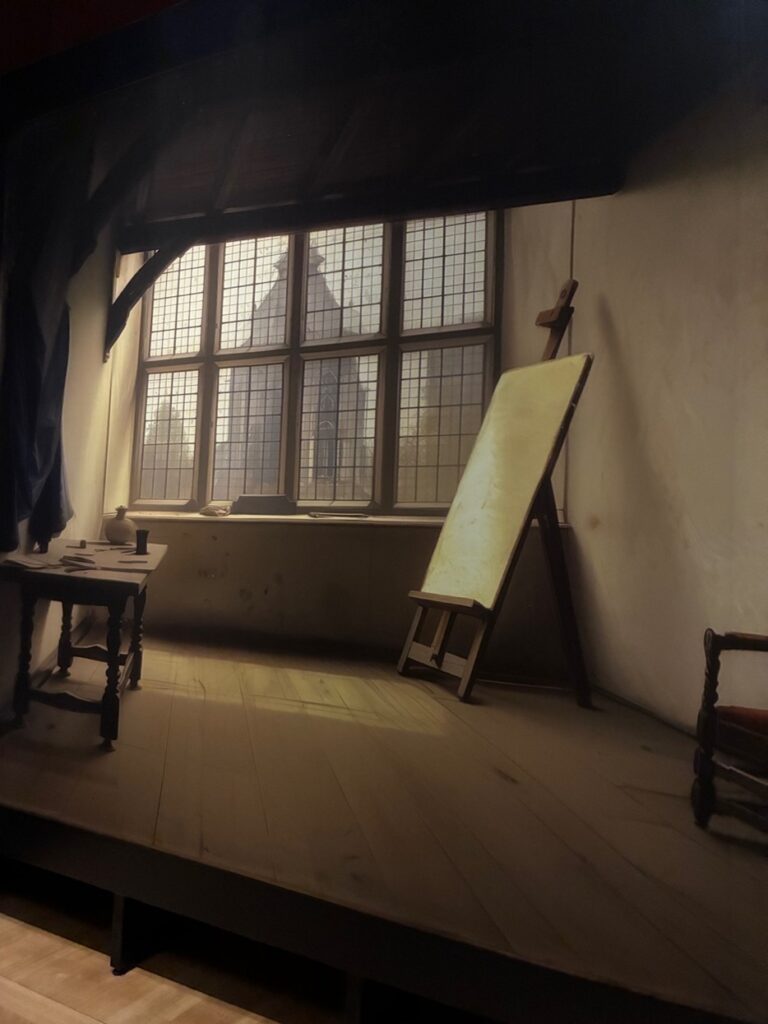
In the final section of Wautier’s exhibition is an AI generated wall-size image of what her studio must have been like (Fig. 14). In a high room with a view of Brussels, Michaelina was able to paint in a kingdom of her very own. Her brother Charles must have procured for her, what no other woman in the seventeenth or later centuries had access to—nude male models.
Michaelina’s Mystery
A Guardian article quotes KHM Director Jonathan Fine as commenting, “We know practically nothing about her from historical documents. Most of what we know, we know from her paintings.”And the story Wautier tells within her canvases is nothing short of epic. She was extraordinarily versatile, capable of still lifes, portraits of young and old, landscapes (The Triumph of Bacchus) and history paintings. At the end of this exhibition, the viewer must realize that there was simply nothing beyond Wautier’s grasp.
Like Emily Dickinson, her life “had stood a loaded gun.” She was clearly a female master painter who had the power to invent and create alongside men. The new exhibition at KHM on Michaelina Wautier created by Gerlinde Gruber and Julien Domercq is a masterful collaboration worthy of this incredible genius who must not be overlooked again. Wautier must be put back in history to inspire and empower other women on their own creative journeys. Differences of gender must not exclude talent but enrich culture.
Michaelina Wautier: Painter is on at Vienna’s Kunsthistorisches Museum through February 22, 2026. The show then moves to London’s Royal Academy of Arts, where it will run as Michaelina Wautier from March 27 to June 21, 2026. There is an exhibition catalog for the show; and Katlijne Van der Stighelen’s new book about the artist is forthcoming in March 2026.
Allison van den Hoek has authored INDELICATE, a novel and screenplay recreating Michaelina Wautier’s character and dramatizing her quest to paint The Triumph of Bacchus.
As Michaelina strives to paint a masterpiece for the Archduke’s Open Commission in 1650s Brussels, she must keep brother Charles from being sent to a fatal debtor’s prison and battle with a wife-seeking army general, a jealous painting priest, and a sly art dealer. But no matter what, she must avoid falling in love with tender church sacristan Henri.
INDELICATE was a Semi-Finalist in Your Script Produced 2025! and a Big Break Screenwriting Competition Quarterfinalist 2025. Her novel In the Wake of a Starry Nightabout Willemien van Gogh was Shortlisted for the Yeovil Literary Prize 2022. Her novel Bargaining with Grace was Longlisted for The Stylist Feminist Prize for Fiction 2021. INDELICATE has the endorsement of Professor Katlijne Van der Stighelen. Allison is grateful to the art historians, restorers of Michaelina’s works, and museums who have given her their time and insight. She is represented by Charlotte Colwill of Colwill & Peddle, an independent U.K. literary agency.
More Art Herstory posts you might enjoy
Museum Exhibitions about Historic Women Artists: 2026
A Year for Dutch and Flemish Women Artists
Dutch and Flemish Women Artists—A Major Exhibition at the National Museum of Women in the Arts, by Erika Gaffney
Historic Women Artists and Still Life at The Hyde Collection, by Erika Gaffney
Rachel Ruysch: The Art of Nature, by Stephanie Dickey
Books, Blooms, Backer: The Life and Work of Catharina Backer, by Nina Reid
Anna Maria van Schurman: Brains, Arts and Feminist avant la lettre, by Maryse Dekker
Alida Withoos: Creator of beauty and of visual knowledge, by Catherine Powell
A Clara Peeters for the Mauritshuis, by Quentin Buvelot
Floral Still Life, 1726—A Masterpiece by Rachel Ruysch, by Lawrence W. Nichols
Rachel Ruysch’s Vase of Flowers with an Ear of Corn, by Lizzie Marx
Women and the Art of Flower Painting, by Ariane van Suchtelen