Guest post by Jane Salvage, nurse, activist and author
Midwives in art and legend
Giotto’s fresco of Jesus’ birth is a Christmas card favorite. All the familiar figures are there. But have you ever noticed the two women bathing and swaddling the baby? They are midwives, Salome and Zebel. You won’t find them in the New Testament—their first known appearance is in a second-century apocryphal gospel.
The legend of the Doubting Midwife
The legend says that when Mary was about to give birth in the cave where they were sheltering, Joseph went off into the hills above Bethlehem in search of a midwife. By great good fortune the first person he met was a midwife, Zebel, who agreed to accompany him to the cave with her colleague Salome.
As they approached they saw a dazzling light emanating from the cave. They were too late—the baby had already been born. Zebel was an instant believer that the Messiah had come, but Salome wasn’t convinced. She decided to examine Mary, but her arm withers in the attempt. Then, upon touching the baby or somehow in the course of helping to bathe him, Jesus performs his first miracle: her arm instantly and fully heals. The first known account of this tale, once well-known but now obscure, comes in the second-century Legend of the Doubting Midwife. Salome the midwife, not to be confused with Salome who danced for Herod, became a cult figure and saint—the most famous midwife ever.
The legend has inspired painters, poets and preachers for nearly 2000 years. Most art historians of the older, white male variety, if they notice the nativity midwives, describe them as handmaidens, shepherdesses, bystanders, lowly figures and “unnamed women.” Yet the midwives appear in countless paintings of holy births, not only of Jesus but also of Mary, her mother Anne and many saints. They usually show the midwives in the foreground, bathing or swaddling the holy infants while the mother rests, typically in a birthing community of nine women. Occasionally a father peers through the doorway.

Historic nativity paintings by women
There’s no way of knowing how many women created nativity pictures. Tenth-century artists illuminating a manuscript in Genoa included an unknown “pintrix”—perhaps a nun. The skeleton of a medieval German nun revealed traces of ultramarine in her dental plaque, from lapis lazuli, used to paint Mary’s robes. Only the best illuminator would be trusted with such a costly pigment. We can imagine her sucking her paintbrush to create a fine point.
Women were usually assigned less important creative tasks, and did the typically invisible female work of childcare, running the household and managing aspects of the business—organizing, feeding and clothing the workers, marketing, buying and selling, and book-keeping.
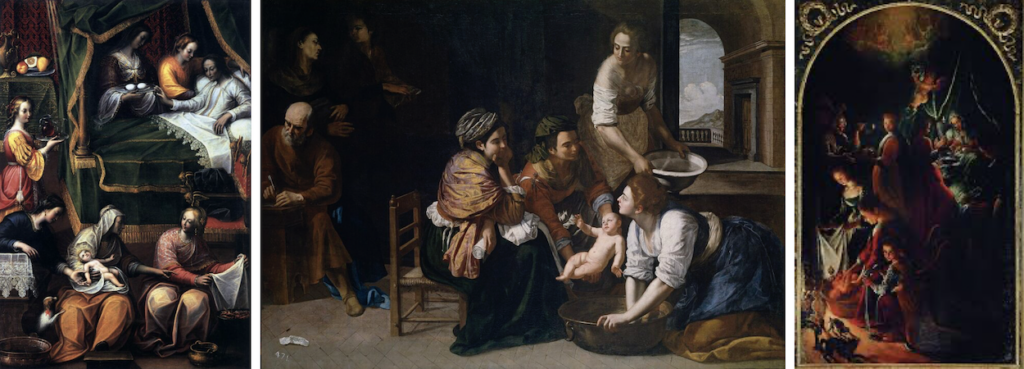
Sadly, I have not identified any painting attributable to a woman of midwives at Jesus’ nativity. Some women, however, including Lavinia Fontana, Artemisia Gentileschi and Orsola Maddalena Caccia, painted birth scenes of the Virgin Mary, Saint Anne, Saint John the Baptist, and other saints.
Lavinia Fontana
Historians regard Lavinia Fontana, a Renaissance painter from Bologna, as the first woman to practice art as a profession. Pregnant for much of her working life, she endured childbirth 11 times. After each birth, she would hire a wet-nurse and go straight back to work. Seven of her children died before their teens. The death of her daughter Laudomia at 14, already a promising artist, was a terrible blow. When she painted religious works with mothers, babies and midwives, we can imagine her understanding and sharing their experiences. Perhaps making them immortal helped to lighten her sorrows.
Fontana’s Birth of the Virgin
Fontana’s tender, meaningful altarpiece of the birth of Mary, with midwives, is a rare 16th-century commission of a female artist. Its original home was St. Biagio church, next to a school for girls, perhaps foundlings. The girl holding the swaddling bands in the foreground may be a pupil—a good way to focus the girls’ attention as participants in the sacred story. The arms of the chair behind her give her the wings of an angel.

The attendants are about to immerse Mary in the bath in front of the fire, not sitting upright as usual. A real baby having her first experience of bathing, she reaches towards her midwife, suggestive of baptism and perhaps a prefiguration of her assumption into heaven. One woman warms a towel; another unrolls swaddling bands. A third woman places a pot of hot stones under a bedcover. Attentive and professional, they handle their tasks with calm precision.
Every birth had two parts, according to 16th-century manuals: the delivery, and the extraction of the placenta, ascribed magical properties throughout history. In one very unusual detail, the old woman holding a lamp receives a basin she’s about to carry away, probably containing the placenta. Fontana’s imagining of this scene drew on personal experience as well as artistic traditions. Fontana probably recorded female figures from life, and drew on her personal experience, proudly signing her name and “pintrix” on her works.
Orsola Maddalena Caccia
Orsola Maddalena Caccia, an Italian nun, painted holy births with midwives. Previously scholars attributed her lively pictures, rich with symbolism and observation, to her father Guglielmo Caccia. He trained her as his assistant when she was still teenage Theodora, mixing pigments and painting secondary figures with her sister Francesca. He founded a convent to house his six daughters, with Orsola as abbess running a successful painting workshop. She sold pictures to the Gonzaga connoisseurs in Mantua. Many of her paintings remain in the small towns for which patrons commissioned them.
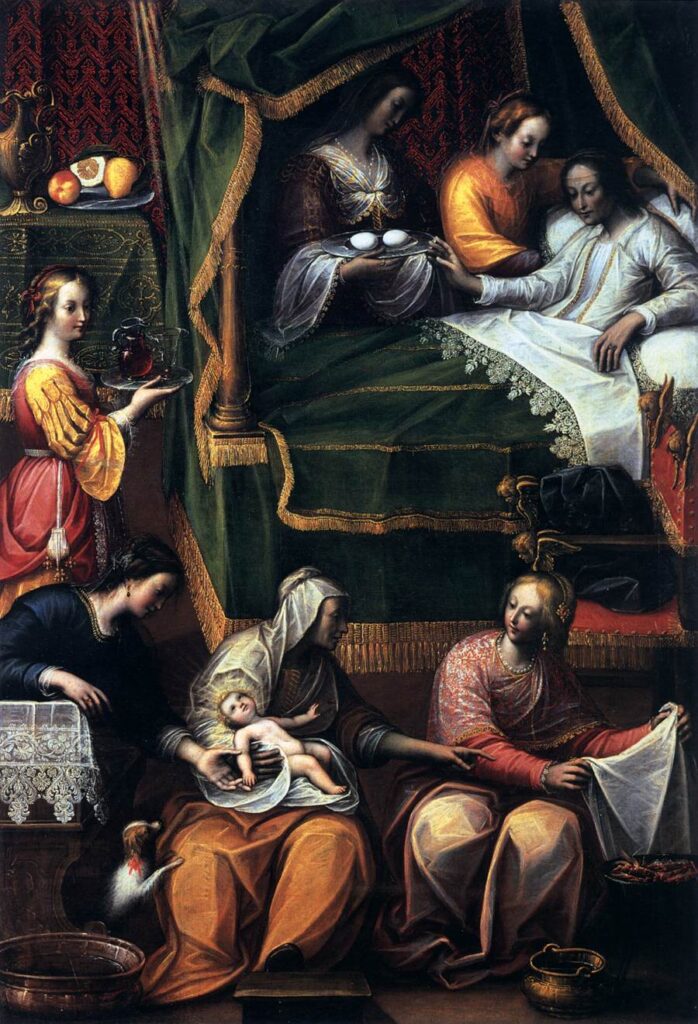
One may wonder how a nun like Orsola knew the details of a birth. Perhaps her convent provided the setting for a discreet high-born birth. Caccia’s Birth of the Virgin painting conforms to tradition in depicting the scene; its midwives, baby bath, and attendants bring symbolically important sustenance. Not unusually, the midwife has the babe in her lap, perhaps after being bathed, with a well-dressed visitor warming the swaddling cloth, dangerously close to the brazier. Actual dogs and cats were not normally permitted in such a setting, but their inclusion in nativity paintings has symbolic meaning. The exhausted mother, Anne, has been helped into bed after using a birthing chair. The food and drink her attendants offer has symbolic value—including eggs for fertility.
Artemisia Gentileschi
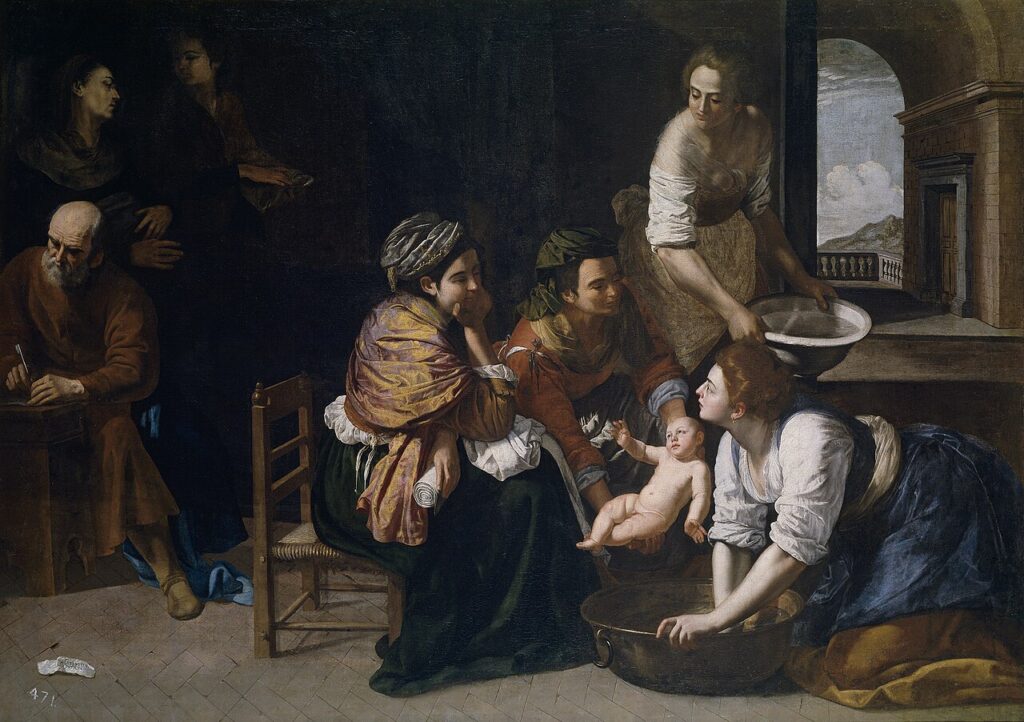
In Artemisia Gentilesci’s nativity of Saint John the Baptist, the flame-haired midwife and her colleague (sometimes described as “maidservants” are about to bath the baby while John’s mother Elizabeth rests in a dark corner. Artemisia Gentileschi was a female artist recognized and lauded in her own time, another rarity. Her mother died when she was 12. Three of her own five children were dead before their first birthday, and another at five years old. Only her daughter Prudenzia survived into adulthood. Childbirth often resulted in long-term internal injury or the woman’s death.
Conclusion
We can only guess at how these Old Mistresses’ own experiences of childbirth and childcare influenced their work. Were they more likely than their male colleagues to depict nativities? If so, was it by choice or under orders? Were they more comfortable than men with painting scenes of births? The frequency of mother and child deaths did not make them less terrible, and women painting nativity scenes surely drew on their own experiences. Their midwives, as in this painting, are almost invariably efficient, busy, and sympathetic.
Many representations of nativity midwives are unsigned and most of the rest are attributed to men. Sadly, no surviving picture known to be by a woman depicts the sinning and healing of Mary’s midwife Salome. Only a handful of scenes of saints’ nativities are known to have been created by women. Some of these portrayals, or parts of them, may have been created by unacknowledged women, as individuals or in a team. Taken together, they are a moving testament to the courage, and expertise of mothers and midwives.

Jane Salvage is a nurse, activist and author; learn more about her at her website. She explores the research behind this post at length in her two books, The Midwives’ Gospel and The Midwife’s Book of Hours. They tell the full story of this neglected tale of human action and divine intervention from a unique and surprising angle, blending history, fable, memoir, feminism and midwifery.
The nativity midwives pose highly topical questions about representations of women, and who gets to tell or suppress our stories. Once familiar in every community, the midwifery profession is in crisis today. Obstetricians routinely perform Caesarian sections that sideline the midwife’s skills and knowledge—while midwifery recruitment is falling. The International Confederation of Midwives says the world needs one million more midwives.
The books also draw on Jane’s experiences as an international nursing and midwifery consultant, teacher and writer. Rooted in her practice, scholarship and advocacy in the UK and worldwide, they resonate with the challenges women worldwide face every day as mothers, leaders and midwives.

More Art Herstory posts you might enjoy
Museum Exhibitions about Historic Women Artists: 2026
A Year for Dutch and Flemish Women Artists
Three Historic Women Artists Exhibitions: A Dispatch from Italy, by Alessandra Masu
Early Modern Women Artists at Auction in 2025, by Erika Gaffney
Portrayals of Mary Magdalene by Early Modern Women Artists, by Diane Apostolos-Cappadona
Lavinia Fontana: Italy’s First Female Professional Artist, by Elizabeth Lev
Exhibiting Artemisia Gentileschi; From the Connoisseur’s Collection to the Global Museum Blockbuster, by Christopher R. Marshall
Plautilla Bricci (1616–1705): A Talented Woman Architect in Baroque Rome, by Consuelo Lollobrigida
Judith’s Challenge, from Lavinia Fontana to Artemisia Gentileschi, by Alessandra Masu
Suor Orsola Maddalena Caccia (1596–1676), Convent Artist, by Angela Ghirardi
Recent Museum Acquisitions of Art by Early Modern Women, by Erika Gaffney
Female Solidarity in Paintings of Judith and her Maidservant by Italian Women Artists, by Sivan Maoz
Plautilla Nelli and the Workshop of Santa Caterina in Cafaggio, by Alessia Motti