Guest post by C.J. Denton, author of La Pittura
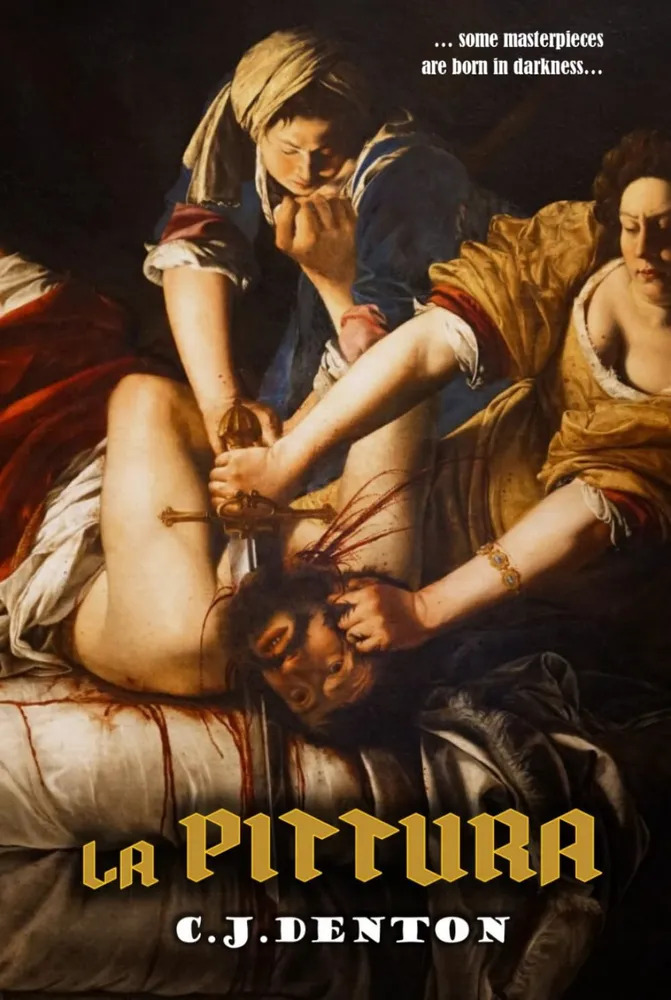
There is a version of Artemisia Gentileschi that has become very familiar. She is young. She has survived a brutal assault and the arguably crueler ordeal of a public trial. She paints Judith leaning over Holofernes, sleeves rolled back as she drives a sword through his neck. Blood spurts wildly across the bed. It is an extraordinary painting, and an irresistible story. So irresistible, perhaps, that it has sometimes threatened to become the story.
There is another Artemisia I find more interesting.
Almost 30 years after her earliest surviving signed painting, we find her in England, in her mid-forties and already carrying a long career behind her. She is no longer the teenage daughter working within Orazio Gentileschi’s Roman world. She has lived in Florence, returned to Rome, worked in Naples and crossed Europe to reach the court of Charles I.
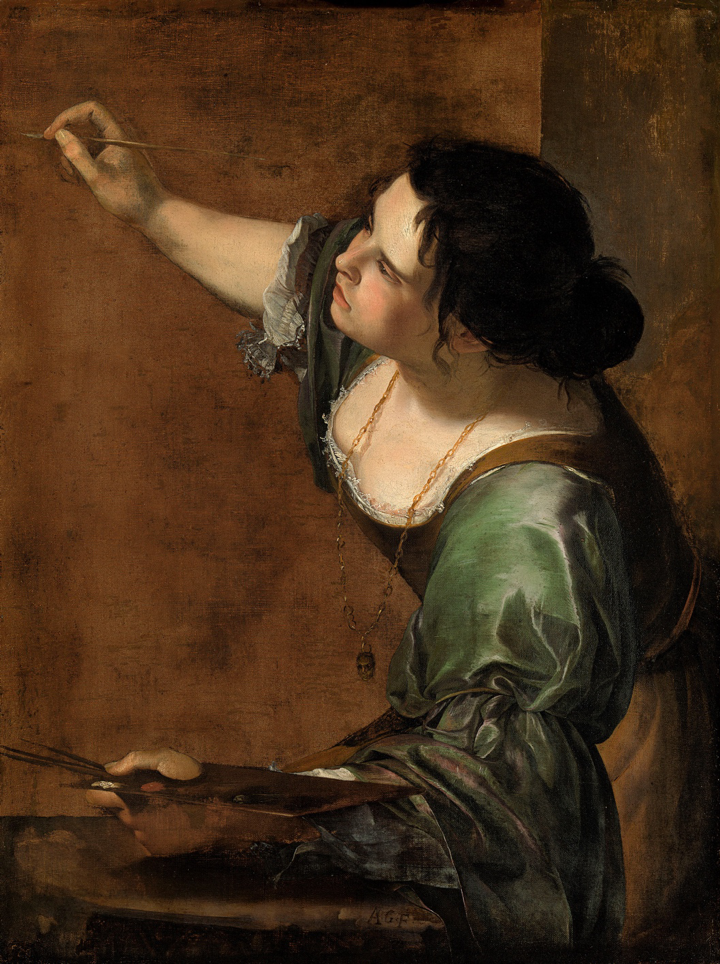
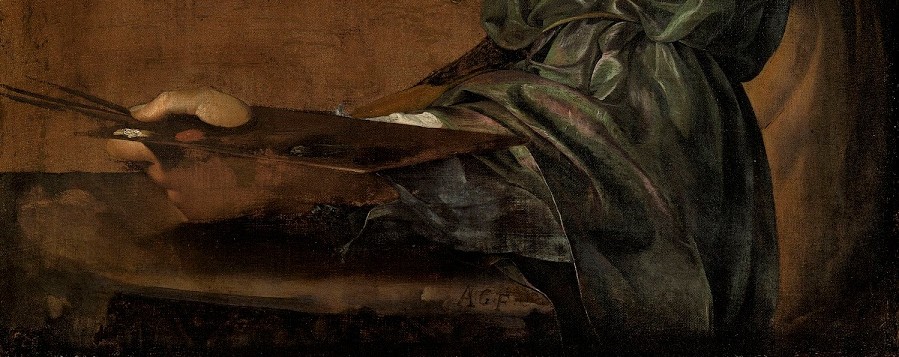
There, she paints herself. She is working. Her body leans towards a canvas we cannot see, her right arm reaching upwards with the brush while the other holds her palette. Her dark hair is loose and slightly unruly, and a gold chain hangs from her neck. She appears completely absorbed in the physical act of making something.
The painting is usually known as Self-Portrait as the Allegory of Painting, or simply La Pittura. That second title contains an extraordinary idea, reflected in the painting itself. Artemisia has not merely painted herself as a painter, but identified herself with Painting.
So how did she get there? How did the teenage girl working within her father’s Roman workshop become a woman capable of presenting herself not simply as somebody who produced paintings, but as an embodiment of the thing she had spent her life doing?
Before the blood
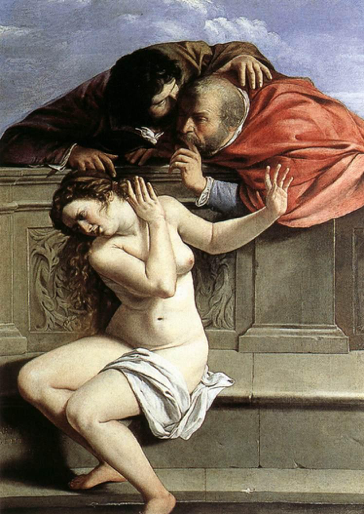
Artemisia was about 17 when she painted Susanna and the Elders, her earliest securely signed and dated surviving work. She was already attempting something ambitious: a large-scale biblical subject centered on the naked female body. Her access to the skills required to do this was unusual. The normal routes into professional painting had developed principally around men. Workshops were predominantly male spaces, formal institutions offered women limited opportunities, and study of the nude figure presented obvious difficulties in a society that placed considerable restrictions upon respectable female behavior.
Artemisia had an advantage that appears repeatedly in the biographies of early modern women artists. Her father was a painter. Orazio Gentileschi could give his daughter access to his workshop, materials and instruction. Through him she could also encounter the professional networks on which an artist depended. Her talent was her own, but the opportunity to develop it came initially through her father.
It is almost frightening to wonder how many other Artemisias in Rome and beyond spent their days sewing, cleaning, selling or serving in a world that never provided them with the particular accident of birth that could open the door to artistic training. Talent alone leaves very little historical trace.
There is something appropriate about beginning with Susanna, because looking itself is at the center of the painting. The two elders crowd behind her, intruding upon her space as she twists away from them. Her discomfort is physical. Whether we should read Artemisia’s own experience into the picture is a more difficult question, particularly because it predates the event that has subsequently dominated so much discussion of her life. What the painting demonstrates beyond speculation is that Artemisia was already an accomplished painter while still a teenager. She was not yet, however, professionally independent.
The problem with Judith
A year after Susanna, Artemisia was raped by Agostino Tassi, another painter who moved within Orazio’s professional circle. The prosecution that followed in 1612 left an unusually detailed documentary record, including Artemisia’s own testimony and the torture inflicted upon her while that testimony was tested.
It is impossible to approach her biography without confronting what happened. The difficulty is knowing when to move on.
Our knowledge of the trial has changed the way generations of viewers have approached Artemisia’s paintings, most obviously the great versions of Judith slaying Holofernes. Once we know her history, the temptation to see Judith’s sword as Artemisia’s revenge is powerful.
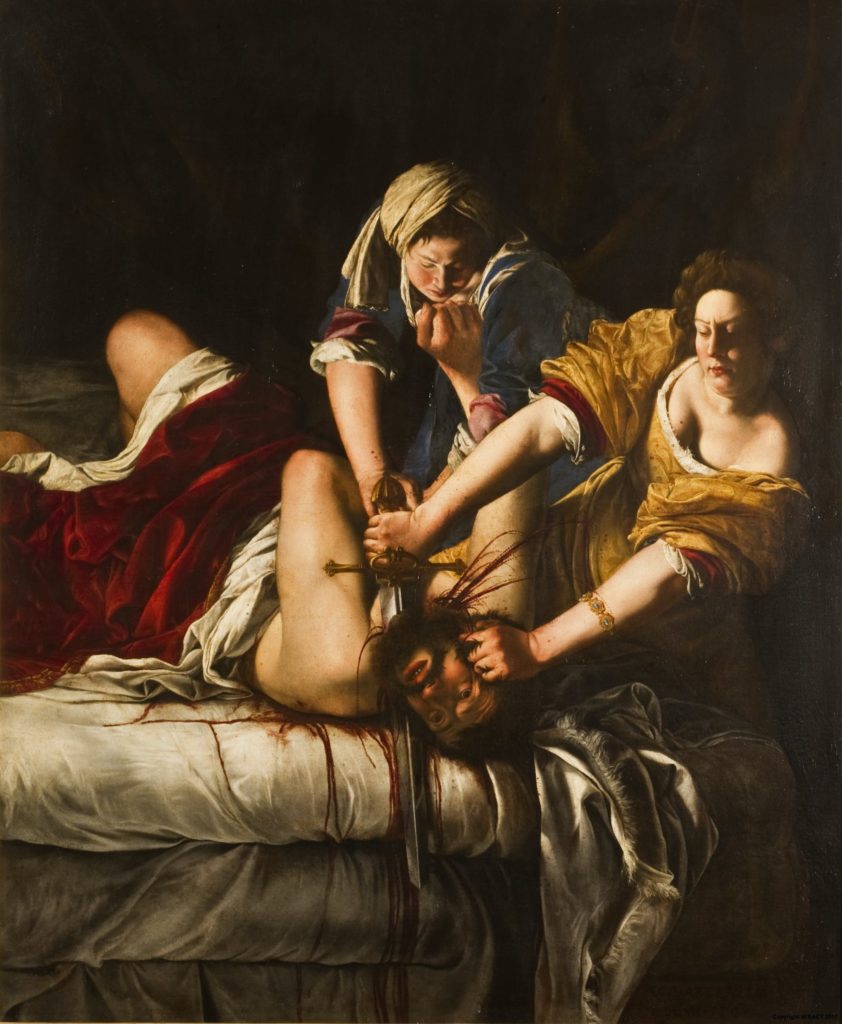
Perhaps personal experience did inform the intensity with which she approached the subject. We cannot prove that it did not. But biography can become a trap when it allows us to stop looking at the artist. Judith was not Artemisia. Holofernes was not Tassi. Violent biblical subjects belonged to the visual culture in which she worked, and Artemisia was a professional painter producing pictures for patrons.
If we insist upon making every violent woman she painted into Artemisia herself, we risk doing something curiously similar to the thing we claim to resist. We define her by the rape all over again.
Her career did not end in the courtroom in 1612. In many ways, it was about to begin.
Florence, and a name of her own
Shortly after the trial Artemisia married the Florentine painter Pierantonio Stiattesi and left Rome for Florence. Distance from Rome also meant distance from Orazio’s immediate professional identity, and during the years that followed Artemisia began to establish relationships that belonged to her.
She entered the orbit of the Medici court and cultivated patrons. She encountered a sophisticated cultural world in which art, science and court politics overlapped, and surviving evidence increasingly allows us to see her operating not simply as a talented painter but as a professional one.
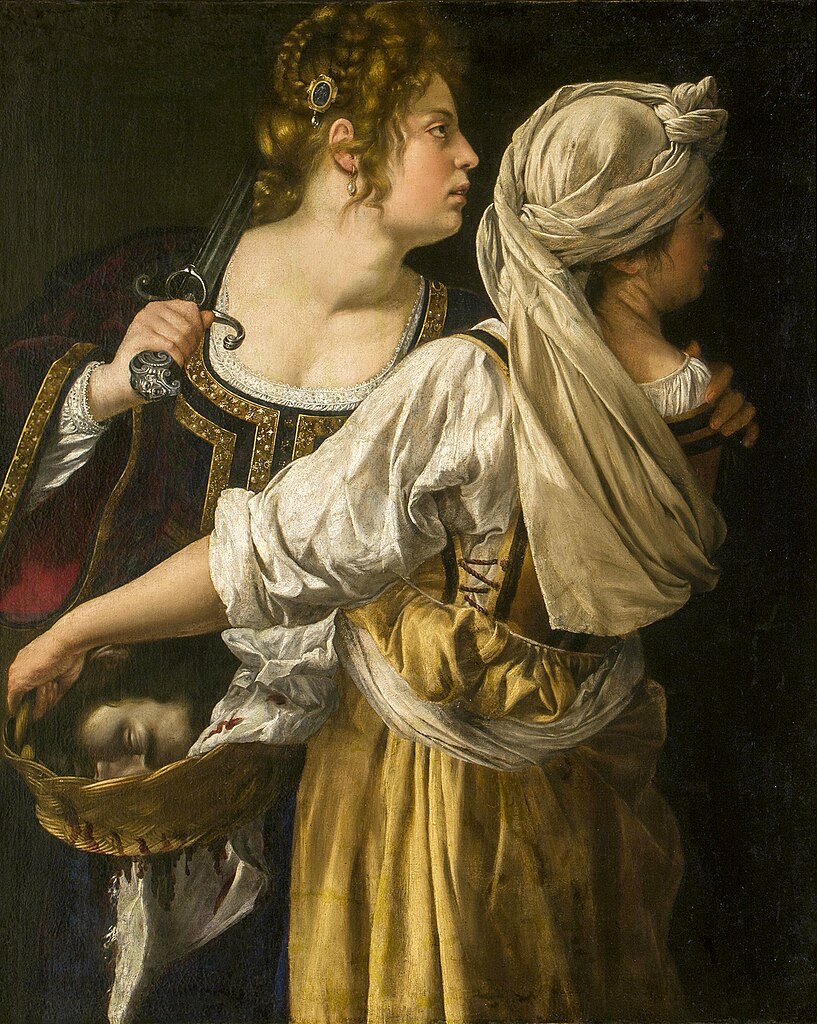
Then, in July 1616, Artemisia was admitted to Florence’s Accademia delle Arti del Disegno, one of the first women to become a member.
It is tempting to make that moment purely symbolic, an early-modern glass ceiling neatly shattered. Its importance was also practical. Membership brought professional standing and connections, giving Artemisia a recognized place within Florentine artistic life. Orazio had provided her original access to painting; Florence allowed her to build an identity that was increasingly her own.
Learning to be seen
Her self-representation during these years becomes particularly interesting. In Self-Portrait as a Lute Player, generally dated to around 1615–17, we meet a very different Artemisia from the woman who will later become La Pittura. She is elegantly dressed and looks directly towards us. The picture participates in a tradition in which music, beauty and refinement could all contribute to the construction of identity.
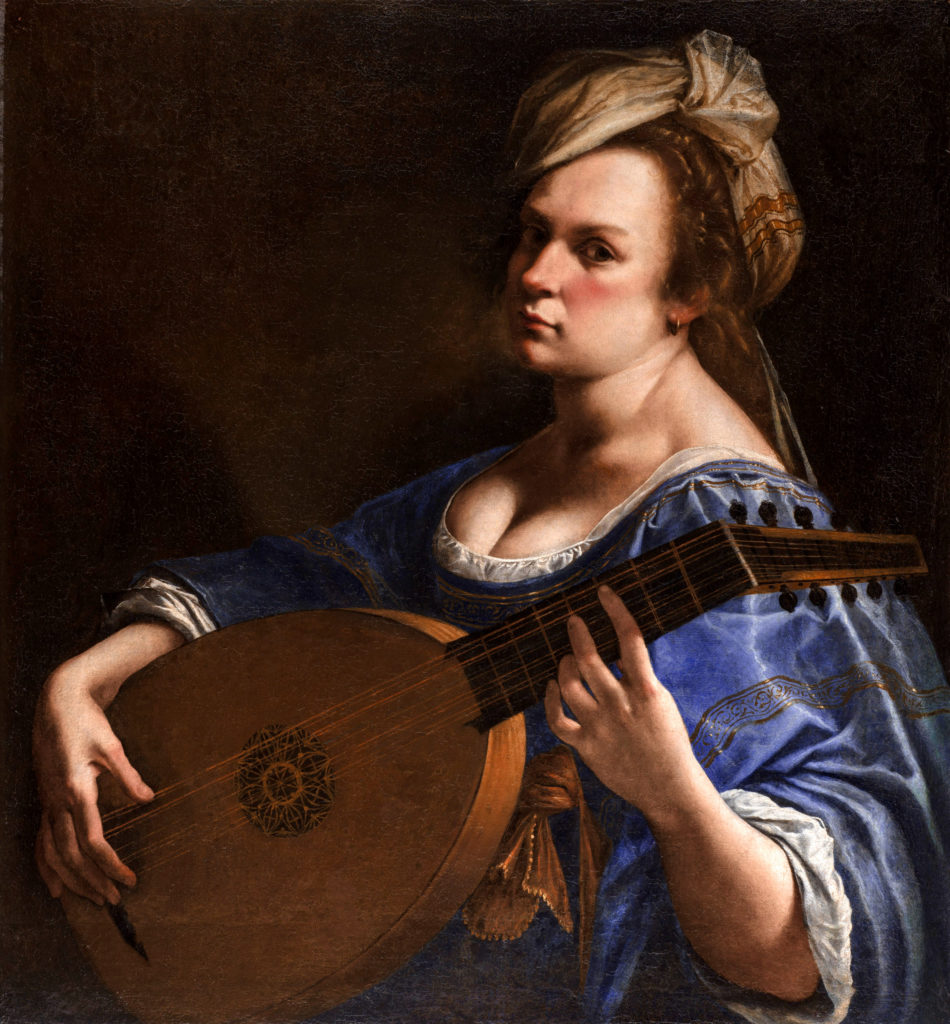
Whatever precise identity Artemisia intended the painting to convey, she was by then increasingly capable of controlling how she appeared before the world. That mattered because an artist’s career depended upon more than ability. Paintings had to be commissioned and paid for. Patrons had to be cultivated. Materials had to be purchased, credit obtained and professional relationships maintained.
Artemisia’s surviving correspondence later reveals someone perfectly capable of discussing the value of her work and dealing with powerful patrons. There is a practical Artemisia in the archive who can disappear when we concentrate too heavily on symbolism: the working painter who needed the next commission.
Painting was becoming not merely something she had learned from her father, but the means by which she could make a life.
The woman keeps moving
That life did not settle comfortably in Florence. Artemisia experienced financial difficulties and eventually returned to Rome in 1620. Her career subsequently took her elsewhere, including Venice and then Naples, where she had established herself by 1630.
Movement matters in understanding her professional identity. Every new city required relationships to be made or renewed, patrons cultivated and a place found within another artistic market. Artemisia managed to do this repeatedly while her personal life changed around her.

Her marriage deteriorated. She had children and suffered the deaths of several of them. Eventually she was operating increasingly independently, supporting a household and running a workshop while continuing to seek significant commissions. We should resist the temptation to turn every hardship into another rung on a ladder leading inevitably towards triumph. Lives do not arrange themselves so conveniently.
But there is a continuity running through Artemisia’s life: she paints. Cities change, patrons change, her relationship with Orazio changes, as do her marriage and family. Her financial circumstances rise and fall. Painting remains.
By the time Artemisia established herself in Naples, she was no longer remarkable simply because she had managed to enter the profession. She had sustained a career within it. Then, late in the 1630s, that career brought her somewhere unexpected: England.
Father and daughter, again
Orazio Gentileschi had travelled to England years earlier and was working at the court of Charles I and Queen Henrietta Maria. Artemisia joined him there in the late 1630s, arriving not as the unknown daughter of an established painter but with a substantial reputation of her own.
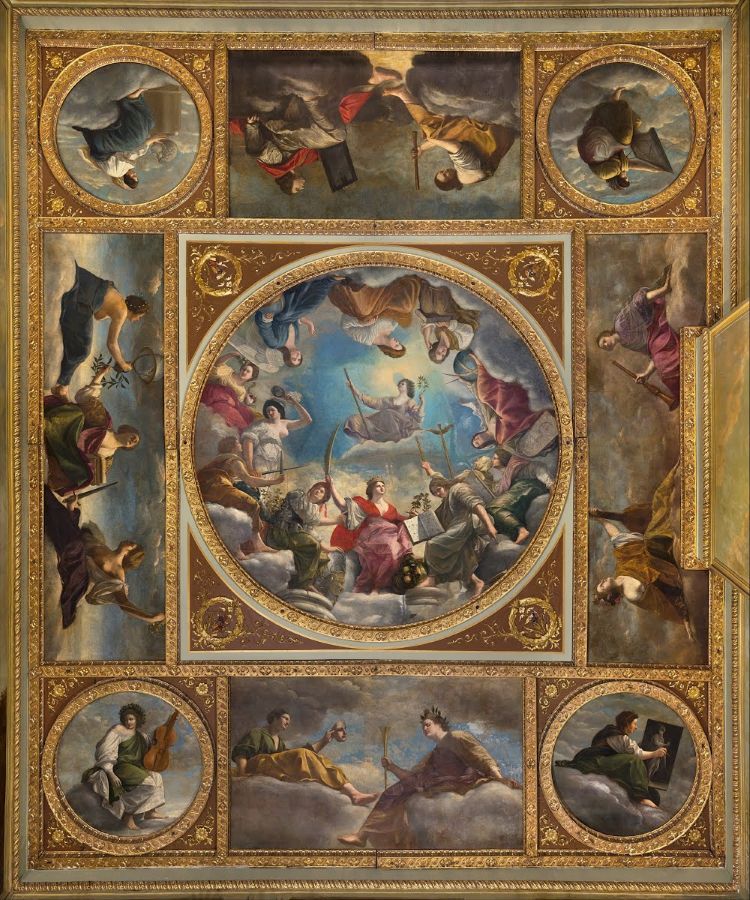
There is something rather moving in the reversal. Nearly three decades earlier, Artemisia had needed Orazio’s workshop because there were so few other ways for a Roman girl to acquire the education of a painter. Now she arrived in London as an established artist in her own right, once again sharing an artistic world with the man who had first taught her.
Orazio died in 1639. Around this period, usually dated approximately 1638–39, Artemisia produced the painting that brings us back to where we began: Self-Portrait as the Allegory of Painting. To understand quite what she was doing, we need another Italian.
What did Painting look like?
Cesare Ripa’s Iconologia was one of the great handbooks of allegory in early modern Europe. First published in 1593, coincidentally the year of Artemisia’s birth, it provided descriptions of how abstract concepts and virtues could be represented visually. Painting, or Pittura, was female.
Ripa described her through a collection of attributes by which an educated viewer might recognize the allegory. She had dark, disheveled hair, held the tools of painting and wore a gold chain from which hung a mask, a reference to imitation.
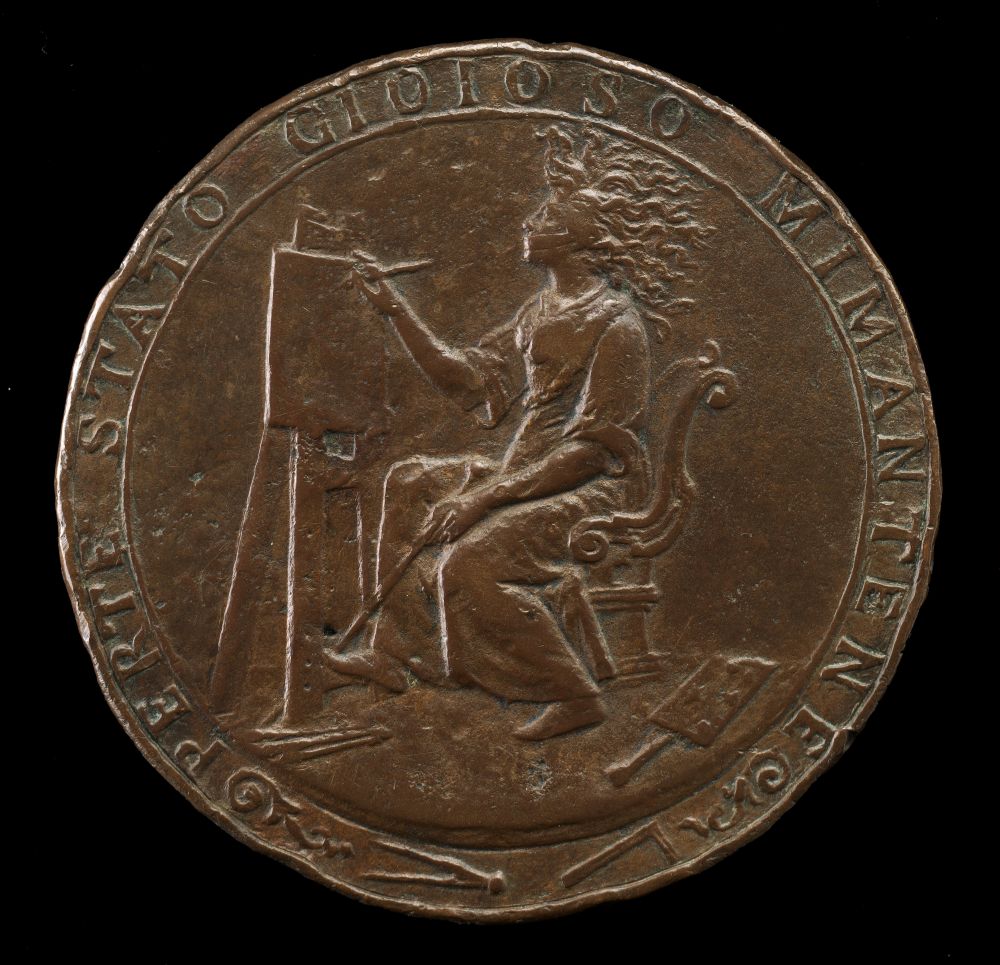
This presented male artists with a small practical difficulty. Painting was a woman. A man could paint the personification of Painting, and he could paint a self-portrait, but he could not naturally make himself both at once. Artemisia could. It was an opportunity created by the very thing that had complicated so much of her professional life: she could step inside the allegory.
There is another intriguing difference between Ripa’s description and Artemisia’s painting. Ripa’s Pittura is also described with a cloth bound across her mouth, an attribute Artemisia does not include. It is tempting to turn that omission into a wonderfully convenient declaration that she refused to be silenced, particularly given what we know of her life. Tempting, but impossible to prove. What matters more is that Artemisia was not mechanically illustrating Ripa. She took an established visual language and made choices within it.
Becoming La Pittura
Look again at the painting after following Artemisia this far. The woman before us is not posed beside the instruments of her profession as though they are attributes added merely to establish her status. She is using them. Her body bends towards her work, creating an awkwardness that makes the image feel active rather than ceremonial. Her hair has escaped its arrangement. She is close enough to the unseen canvas that we seem almost to have interrupted her.
We cannot see what she is painting, and I think that absence matters. If Artemisia had shown us the picture on the easel, our attention would inevitably have divided between the woman and the work she had produced. Instead, the act of painting becomes the subject. We see the concentration and physical movement through which the unseen image is being made.
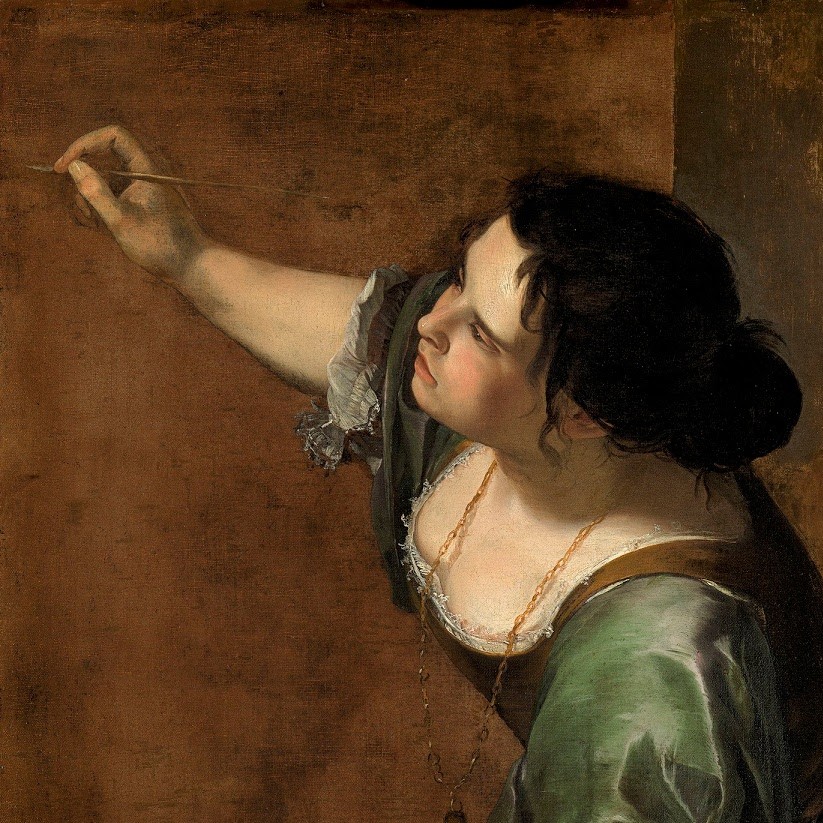
Ripa supplies the visual language, but Artemisia does something remarkably personal with it. She does not merely stand beside Painting; she makes herself Painting. There is an important scholarly debate around how literally we should understand the work as a self-portrait, an allegory or an ingenious fusion of both, and we cannot know precisely what Artemisia intended every viewer to understand. Any attempt to turn the painting into a simple declaration of modern female empowerment risks replacing one convenient version of Artemisia with another.
A life lived in paint
But after following her career from Rome to London, it is difficult not to feel the force of what the image permits her to claim. Painting is no longer merely a skill taught in Orazio’s workshop. It has paid her bills and, at times, failed to pay them. It has taken her into academies and royal courts, brought her patrons, required her to negotiate and travel, and given her a professional existence capable of surviving changes in city and family circumstance. It has been the constant through a life that history has subsequently tried to define in so many other ways.
By the time she paints La Pittura, the distinction between the woman and her profession has become difficult to maintain. Painting is not simply something Artemisia does; it has become part of how she exists in the world. In the self-portrait, perhaps she finally found a visual language capable of expressing that.
Beyond Judith
None of this requires us to discard Judith. Judith Slaying Holofernes remains one of Artemisia’s great achievements, and the particular force with which she approached female protagonists deserves the attention it receives. The problem comes only when Judith becomes a locked door through which every visitor is required to enter.
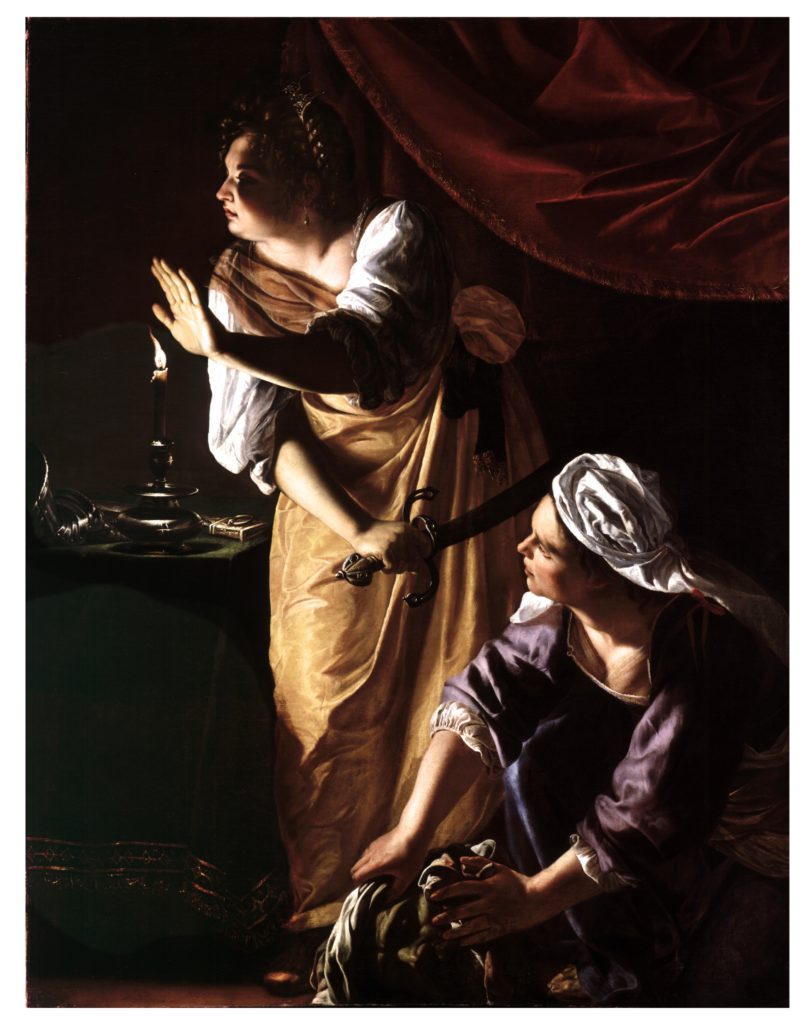
Artemisia lived and worked for decades after the trial. She negotiated with patrons, moved between artistic centres, maintained a workshop and developed a reputation capable of carrying her to royal courts. The surviving paintings encompass far more than female revenge, just as the surviving woman encompassed far more than the events of 1611 and 1612. Perhaps La Pittura offers another doorway.
Here there is no man for Artemisia to kill and no voyeur from whom she must turn away. There is not even a finished painting for us to judge. There is simply Artemisia, working. That is ultimately why this painting gave my novel La Pittura its name. I became interested in an Artemisia for whom painting was not the decorative background to a dramatic biography, but the thread running through it.
That does not make La Pittura a more truthful Artemisia than Judith, or Susanna, or any of the other images onto which later viewers have projected versions of her life. It simply allows us to ask a different question. Instead of beginning with what happened to Artemisia and searching the canvas for its consequences, we can begin with the thing she kept returning to throughout her life: painting.
What remained
Her world changed repeatedly, but painting remained. We began by asking how Artemisia Gentileschi became La Pittura. By the time we reach London and look at the woman leaning towards that unseen canvas, the question feels slightly wrong. She had been painting for almost 30 years by then, through marriage, debt, bereavement and repeated moves across Europe.
Perhaps, by then, she simply knew how she wanted to paint herself.
Author biography
C.J. Denton is the author of La Pittura, a literary historical thriller centered on Artemisia Gentileschi and set within the artistic world of seventeenth-century Italy. Published on August 31, 2026, the novel takes its title from Artemisia’s Self-Portrait as the Allegory of Painting.
More Art Herstory blog posts about Artemisia Gentileschi:
Female Solidarity in Paintings of Judith and her Maidservant by Italian Women Artists, by Sivan Maoz
Judith’s Challenge, from Lavinia Fontana to Artemisia Gentileschi, by Alessandra Masu
Exhibiting Artemisia Gentileschi; From the Connoisseur’s Collection to the Global Museum Blockbuster, by Christopher R. Marshall
Artemisia Gentileschi: What Wasn’t in the London Exhibition and Why it Matters, by Jesse Locker
Two of a Kind: Giovanna Garzoni and Artemisia Gentileschi, by Mary D. Garrard
“Artemisia” at the National Gallery: A Review, by Sheila McTighe
The Priceless Legacy of Artemisia Gentileschi: A Curator’s Perspective, by Judith W. Mann
Talking Artemisia Gentileschi with Joy McCullough, Author of “Blood Water Paint”
Art Herstory Resource Page: Artemisia Gentileschi