by Erika Gaffney, Art Herstory Founder
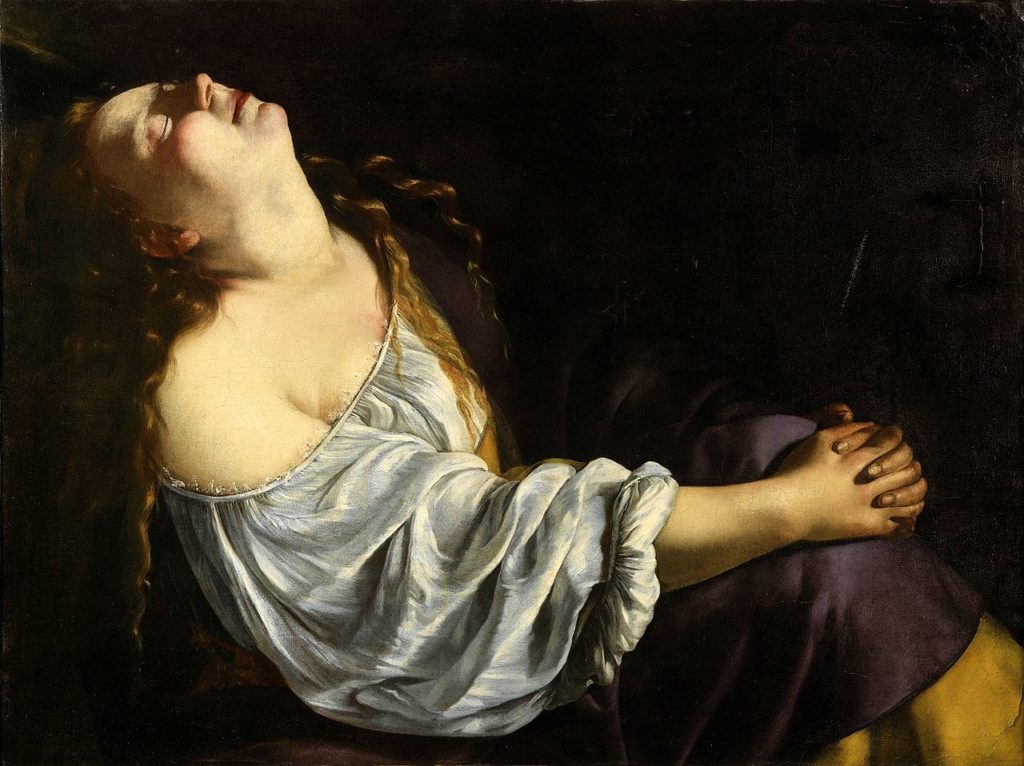
Early this month, the National Gallery of Art disclosed its purchase of Mary Magdalene in Ecstasy, a painting by Baroque artist Artemisia Gentileschi. The announcement has resonated throughout the art world. According to the museum’s press release, it is “the first singular work by Gentileschi to enter the National Gallery’s collection. Its acquisition meaningfully expands the museum’s holdings of Italian Baroque paintings by adding a defining artwork by one of the seventeenth century’s most celebrated artists.”
Art by early modern women at the National Gallery of Art
The press release gives a brief account of the painting’s history. Prior to this acquisition, it spent centuries in a private collection, disappearing from the public record. Mary Magdalene in Ecstasy was rediscovered in 2011; since then, it has featured in numerous publications and exhibitions. Widely considered by art historians to be one of Gentileschi’s greatest works, it is a prominent addition to the nation’s art collection.
It is exciting that Mary Magdalene in Ecstasy is now in a public collection, which increases its accessibility to art lovers. Readers who visit the National Gallery of Art to see this painting could seek out other works by early modern women that the museum has recently acquired—
- 2022: Virgin and Child, by Luisa Roldán; and Lucia Bonasoni Garzoni, by Lavinia Fontana
- 2023: The Annunciation, by Caterina Angela Pierozzi; Still Life with Apples, Pears, Cucumbers, Figs, Plums, and a Melon, by Fede Galizia; Moses ter Borch Holding a Kolf Stick, by Gesina ter Borch (joint attribution with Gerard ter Borch); and Still Life with Flowers in an Alabaster Vase and Fruit, by Anne Vallayer-Coster
- 2024: Still Life with a Basket of Peaches and Grapes, by Louise Moillon
The National Gallery of Art also holds centuries-old art by women that it acquired in the more distant past. The permanent collection includes paintings or drawings by such makers as Rosalba Carriera, Barbara Regina Dietzsch, Angelica Kauffman, Adelaide Labille-Guiard, Judith Leyster, Clara Peeters, Elisabetta Sirani, Maria Verelst, and Élisabeth Vigée Le Brun.
Public collection acquisitions of early modern women’s art in 2025
The National Gallery of Art is the latest museum to announce the acquisition of an early modern woman’s work. However, it is by no means alone among public institutions in adding to its collection works by women of the sixteenth, seventeenth and eighteenth centuries. And Mary Magdalene in Ecstasy is not the only Artemisia Gentileschi work in recent months to enter a museum collection! (See below.) As we have noted elsewhere, inventory of such art is obviously and necessarily limited. Yet art by female makers of the distant past does still appear on the art market, and may also materialize in donations from private collectors to museums.
Here we present—in chronological order by date of birth (in some cases approximate)—museum acquisitions of early modern works by women that the Art Herstory newsletter reported during 2025. Inevitably there will be acquisitions we did not know to include in newsletter issues last year. On that basis, we cannot claim that the following list is comprehensive. We would love to know about any relevant additions to public collections that we missed.
Sofonisba Anguissola (c. 1532–1625)
Last September, Stockholm’s Nationalmuseum announced its purchase of Portrait of a Canon Regular, a painting by Sofonisba Anguissola from the mid 1550s. Though the museum owns at least two dozen works attributed to early modern women, this is the first work by the artist—or by a sixteenth-century woman—to enter its collection.

Artemisia Gentileschi (1593–after 1654)
Also in September 2025, Denmark’s Nivaagaard Collection acquired a Susanna and the Elders by Artemisia Gentileschi. Although it does not seem to have been a common theme with other early modern women artists, Gentileschi painted at least half a dozen versions of the biblical story. A different Gentileschi Susanna depiction was in the news in 2023, when (as reported in Hyperallergic) the Royal Cultural Trust acknowledged it had in 2018 uncovered a painting in storage which, during conservation efforts, they attributed to the Italian Baroque artist.
The Nivaagaard Collection press release declares their Gentileschi painting to be “the most important addition made to the collection since 1908.”

The reference is to the year (1908) in which a donor bestowed to the museum a family group portrait by Sofonisba Anguissola. In autumn 2022, when the exhibition Sofonisba–History’s forgotten miracle opened at the Nivaagaard Collection, the museum believed the Anguissola family portrait to be its only work by an early modern woman artist. But during the course of the show, new research revealed this belief to be incorrect. The painting now titled Portrait of the Artist’s Mother-in-law was discovered to be the work of Sofonisba’s sister, Europa Anguissola!
Last December, the María Cristina Masaveu Peterson Foundation announced its purchase of Virgin Nursing the Child, by Artemisia Gentileschi. Though technically it is a private collection, the Foundation promotes a greater knowledge and appreciation of its holdings by organizing exhibitions and publishing and research projects. The Foundation put the Gentileschi painting on display for the first time in Spain. It is to be hoped that it will be available for public viewing again in the future.

Virginia Vezzi (1600–1638)
The Los Angeles County Museum of Art (LACMA) announced in April 2025 that members of LACMA’s Collectors Committee helped the museum acquire (among other works) Self-Portrait as Saint Catherine of Alexandria, by Virginia Vezzi (also known as Virginia da Vezzo). For LACMA, the painting has special resonance. The museum also owns Virginia da Vezzo, the Artist’s Wife, as the Magdalen (c. 1627), by Simon Vouet, for which Virginia Vezzi is the model.

María Josefa Sánchez (active c. 1639–1652)
Last July, the Baltimore Museum of Art announced its acquisition of a cell cross—or cruces de celda—by María Josefa Sánchez. The painting’s format is unique in that it follows the shape of the wooden cross; it is signed and dated at the base. And while admittedly we did not learn of it in 2025, at some point during the year the Princeton University Art Museum purchased a different cell cross by the same artist.
About ten such crosses by Sánchez still survive today. At least five of them are now in American public collections—the Art Institute of Chicago; Oberlin’s Allen Memorial Art Museum; SMU’s Meadows Museum; and now the Princeton University Art Museum and the Baltimore Museum of Art. Learn more about this painter in the Art Herstory guest post Discovering Early Modern Women Artists in Iberia, by Cathy Hall-van den Elsen.
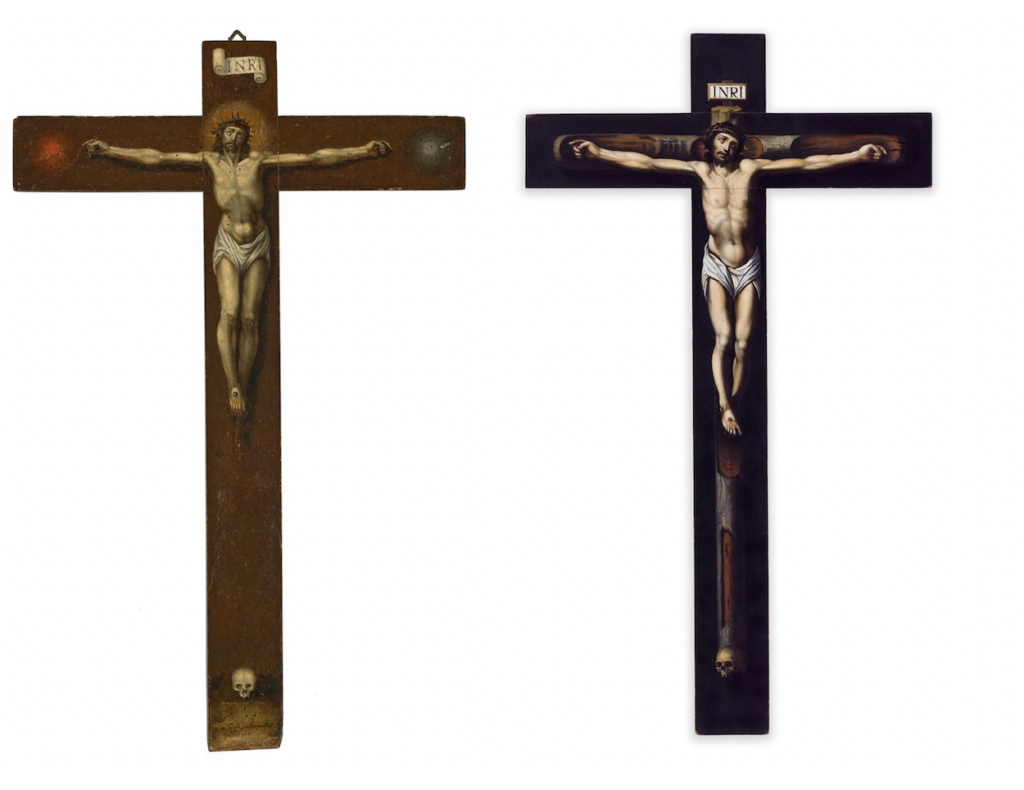
Right: Cell Cross (Cruz de Celda), c. 1640–50, María Josefa Sánchez; Princeton University Art Museum
Luisa Roldán (1652–1706)
In September 2025, the Museum of Fine Arts Houston disclosed its purchase of Luisa Roldán’s Virgin of the Immaculate Conception. According to ArtDaily, the museum characterized the work in this way: “This exquisite painted terracotta reflects Roldán’s characteristic delicacy of touch, which imbues the figure with a graceful elegance and youthful innocence.”

Museums have been acquiring sculptures by Luisa Roldán at an increased rate this decade. For example, the Philadelphia Museum of Art and the National Gallery of Art added Roldán works to their permanent collections in 2024 and 2022, respectively. Last November in Spain, two terracotta sculpture groups came up for auction. They were deemed not exportable; the Spanish government acquired them for the nation. Rest on the Flight into Egypt is destined for Madrid’s Museo del Prado. Education of the Virgin (or The Virgin Learning to Read) goes to the National Museum of Sculpture in Valladolid. In 2024, according to Todo Alacante, Spain’s Ministry of Culture acquired an Ecstasy of the Magdalene sculpture by Luisa Roldán for the Valladolid museum.
The renewed attention this decade to the Spanish sculptor manifests in activity even beyond museum acquisitions. In Winter 2024–25, Spain’s National Sculpture Museum hosted the exhibition Luisa Roldán: Royal Sculptor. (Olivia Turner reviewed the show for the Art Herstory blog.) And Catherine Hall-van den Elsen’s book Luisa Roldán is the inaugural volume of the book series Illuminating Women Artists.
Catharina Ykens II (1659–after 1689)
Scholars do not yet know much about seventeenth-century Flemish artist Catharina Ykens II. So far, experts have identified six extant paintings by her hand. Last June—just a few months before purchasing Gentileschi’s Susanna and the Elders (see above)—Denmark’s Nivaagaard Collection acquired two of those six paintings. Pendant works, the two floral still lifes depict a decorated porcelain vase on a stone table. Each floral arrangement features two bulbous pink roses, though the flowers around the roses vary. Catharina Ykens II is the first female painter in the museum’s Dutch and Flemish Baroque collection.

Anna Waser (1678–1714)
In May 2025, curator Megan Pignataro disclosed on Instagram that the Toledo Museum of Art added Anna Waser’s Self-portrait as the Goddess Flora to its European works on paper collection. Born in Zurich to a wealthy family, Anna Waser displayed from an early age talent in both drawing and miniature painting. Waser spent four years under the tutelage of Joseph Werner. She was the only female artist training in his studio at that time. Today, paintings, drawings, and engravings by Anna Waser are held in private and public collections. Among the other museums and libraries that hold her works are the Louvre, Kunsthaus Zürich, Zentralbibliothek Zürich, and ETH-Bibliothek,

Barbara Regina Dietzsch (1706–1783)
In December 2025, Cornell University’s Herbert F. Johnson Museum of Art announced on Instagram its purchase of A Red, White, and Yellow Parrot Tulip, a Butterfly, and a Beetle, by Barbara Regina Dietzsch. Though we don’t have a lot of information about the German artist’s life, many of her artworks still exist. She specialized in watercolor and gouache paintings of animals and plants. Museums all around the U.S. and Europe hold her drawings; for a list of at least 18 such institutions, visit our Barbara Regina Dietzsch resource page. In 2024, Dartmouth College’s Hood Museum of Art acquired Dietzsch’s Dandelion with Butterfly and Carnation with Butterfly. Learn more about this artist in the Art Herstory guest post Barbara Regina Dietzsch: Enlightened Flower Painter, by Andaleeb Badiee Banta.

Angelica Kauffman (1741–1807)
The Fine Art Museums of San Francisco (FAMSF) issued a press release in March 2025 highlighting the acquisition of Celadon and Amelia (Summer) and Palemon and Lavinia (Autumn), both by Angelica Kauffman. The press release describes the artworks as “intimate, jewel-like paintings on copper.” While these are not the first Kauffman works the museum has acquired, they appear to be the first Kauffman paintings to be owned by FAMSF. The museums add the latest Kauffman acquisitions to the four prints and one drawing by the artist that the collections already hold.

Right: Palemon and Lavinia (Autumn), c. 1781, by Angelica Kauffman; Fine Art Museums of San Francisco
Maria Katharina Prestel (1747–1794)
In the same May 2025 Instagram post in which Megan Pignataro announced the acquisition of the Anna Waser drawing, she disclosed that the Toledo Museum of Art now owns Truth Triumphs Over Envy, by Maria Katharina Prestel. The eighteenth-century German-born printmaker was both successful and prolific. Experts have identified more than 73 etchings she reproduced of works by Dutch, German, and Italian artists. In acquiring this etching and aquatint, the Toledo Museum of Art joins a number of other institutions that own a version of the work, including The Met, The National Gallery of Art, the Art Institute of Chicago, the British Museum, and the Chazen Museum of Art.

Adélaïde Labille-Guiard (1749–1803)
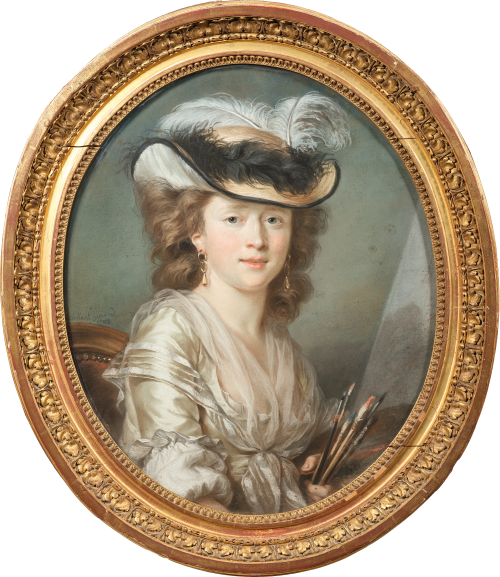
Late last year, the Palace of Versailles acquired—in dramatic fashion—a newly rediscovered pastel self-portrait by Adélaïde Labille-Guiard. In December, the Paris auction house Tajan offered the pastel-on-paper self-portrait; it generated a sale price that set a record for this artist. But as the gavel came down, a representative of the museum intervened to invoke the right of pre-emption, claiming the work for Versailles. A press release from Versailles calls the self-portrait “a work of exceptional importance.” According to this document, the self-portrait “joins a unique ensemble of portraits of members of the Royal Academy of Painting and Sculpture, in which only a few women are represented.”
Élisabeth Louise Vigée Le Brun (1755–1842)
The National Gallery of Canada purchased Élisabeth Louise Vigée Le Brun’s Study for the Figure of Innocence in March 2025. Vigée Le Brun executed the study in preparation for her painting Innocence Taking Refuge in the Arms of Justice, which belongs to the Musée des beaux-arts d’Angers. This drawing on blue paper entered the National Gallery of Canada’s collection ten years after another work by the artist. In 2015, an anonymous Canadian collector donated Vigée Le Brun’s painting Countess Anna Ivanovna Tolstaya to the museum.

What will be the next exciting acquisition?
When it comes to early modern women’s art, the National Gallery of Art’s purchase of Gentileschi’s Mary Magdalene in Ecstasy is the first major acquisition announcement of 2026. But it won’t be the last. While we don’t yet know what, specifically, the coming year holds, we feel confident that! Would you like to keep apprised of museum acquisitions of art by women? Consider subscribing to the free monthly Art Herstory newsletter! Join by visiting the Art Herstory landing page; scroll to the very bottom and complete the simple form. Or, email erika@artherstory.net with your request to subscribe.
Erika Gaffney is Founder of Art Herstory. Follow Erika on Bluesky, LinkedIn and Facebook.
More Art Herstory posts you might enjoy
Museum Exhibitions about Historic Women Artists: 2026
A Year for Dutch and Flemish Women Artists
Early Modern Women Artists at Auction in 2025, by Erika Gaffney
Finding Catherine Read, by Adam Busciakiewicz
The Priceless Legacy of Artemisia Gentileschi: A Curator’s Perspective, by Judith W. Mann
Angelica Kauffmann: Grace and Strength, by Anita V. Sganzerla
Historic Women Artists in Public Collections: The Kimbell Art Museum, by Olivia Turner
Suor Orsola Maddalena Caccia (1596–1676), Convent Artist, by Angela Ghirardi
Portrayals of Mary Magdalene by Early Modern Women Artists, by Diane Apostolos-Cappadona
Angelica Kauffman: Art, Music and Poetry, by Ellice Wu
Two of a Kind: Giovanna Garzoni and Artemisia Gentileschi, by Mary D. Garrard
Female Solidarity in Paintings of Judith and her Maidservant by Italian Women Artists, by Sivan Maoz
Plautilla Nelli and the Workshop of Santa Caterina in Cafaggio, by Alessia Motti
Roma Pittrice: Women Artists at Work in Rome Between the Sixteenth and Nineteenth Centuries, by Alessandra Masu
Do We Have Any Great Women Artists Yet? by Sheila ffolliott
The Politics of Exhibiting Female Old Masters, by Sheila Barker